After about 4 weeks old, the chickens, Jumbo X Cornish Cross broilers, have enough feathers to live outside without supplemental heat. They are also large enough (I hope) to deter attacks by hawks. Although I lack a secure chicken house on pasture in which they can spend the night, so I’m still having to carry them back and forth from the chicken house to the pastured area, at least they can roam about all day without supplemental protection. Here’s a video of them enjoying freedom.They are inside electrified poultry netting. I opened the door to the chicken house in hopes that they’d roam about and find their own pasture, but they really just don’t want to move. They’d rather sit in front of the food container and eat. When I take it away, they move more as they look for something to eat. This breed is not like my “normal” chickens, who are never still unless they are laying an egg or taking an afternoon nap. The rest of the time the “normal” ones are chasing bugs, scratching in the mulch, or just walking around.
Month: November 2014
Providing chicks with pasture in November (and getting them out of my garage!)
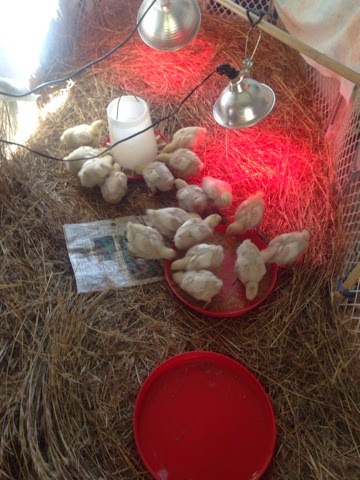
Just in case you were wondering, it’s not a good idea to raise 17 Jumbo X Cornish Cross chickens in your garage. I raised 9 chicks of traditional breeds in my garage, and their manure and mess was not a problem. Although I read all the information I could find about raising Jumbo X Cornish Cross chickens, which are similar to the breed of chicken people usually eat from the grocery store or from most farms, I did not truly realize how quickly they would grow. They eat voraciously, and what goes in, must come out.
 |
| Here they are inside the garage in the “brooder” made of baby gates and hay on the floor |
Because it’s November, and too cold for the chicks to stay outdoors unprotected, I tried a couple of methods of letting them have some time outdoors, but discovered that they could not stay outdoors long without heat, or else they required constant supervision to ensure their safety from hawks.
 |
| Outside in the hoop house where they belong |
My husband and I built these hoop houses, some from bent cattle panels, and some from PVC pipe, covered them with plastic, and now I have a solar-heated chicken brooder that protects them from hawks. This structure will not protect them from four-legged predators, and it won’t keep them warm at night. However, depending on the weather, I can take them outside when the sun strikes the structure in the morning, and I bring them back inside the garage in the late afternoon.
I am able to do this because I am at home during the day and I can monitor the temperature under the plastic. Usually, I start out the day with the plastic completely closed, then in an hour or two open the ends, and, depending on how hot the day becomes, pull aside some of the plastic on the roof. The first time I tried this, I went out to check on them an hour after I put them in, and they were panting from the heat. I opened the plastic, and they were fine. Another day, a strong wind blew aside the plastic and I had to catch some of the chicks. Now that I understand how it works, I leave them for a few hours, but please do not leave your chickens in this structure all day without checking on them.
Edited at 12:09 PM: I just got back inside from checking on them, and it’s quite warm here–75 degrees or so today. Even with some of the plastic pulled back, they were still panting, so I made some further modifications with some plastic chicken fencing to allow them more air, and laid some tin roofing along the sides for shade. My “normal chickens do fine in the heat of a South Carolina August day, but I was concerned that these might not be able to withstand even a little discomfort.
It’s also not at all secure against four-legged predators or safe to keep them in during the night. I have them inside a fenced garden, which is inside an electric fence, so they are safe (but I’ll never say they are completely safe) during the day. Mr. Raccoon could easily climb the fence and get them at night, though, but he’s not usually active during the day.
 |
| I take them back and forth into the garage in a plastic tote. They hate this. |
Catching them is becoming more and more difficult, and they dislike the experience, but I believe I make up for the 5-10 minutes of anxiety while I catch them by allowing them the fun and nutrition available in the hoop house. And, that’s a whole day that they are doing their business outside, where it belongs, and enriching my garden soil in the process. I have discovered that if I take the food away for a couple of hours before it’s time to catch them the little beggars are so ravenously hungry that they rush to the feeder and I can catch them without chasing them. These birds don’t eat with one eye watching for predators like my other chickens. I’ve never been able to sneak up on a “normal” chicken.
In the future, I’ll get these chicks in late August, perhaps, so they will have warm weather while they are babies and can mature in the cooler weather of October, when they have feathers for warmth, can stay outside all the time, and will be large enough to deter most hawk attacks.
My experiment with meat chickens
I’ve purchased meat from pastured poultry producers for awhile now, although I do revert to eating meat from the grocery store, too. In an ideal world, I’d either raise all of my own meat, or I’d buy it all from farmers I know personally. Actually, in an ideal world, I’d probably eat less meat than I do, but I have to consider the dietary preferences of my husband, too. In an effort to have a more sustainable source of food, and because I find raising chickens endlessly interesting, I ordered 20 Jumbo X Cornish Cross chicks from a hatchery. Whenever you eat chicken meat, unless you have purchased it from a farmer who focuses on heritage breeds, you eat a chicken closely related to the Jumbo X Cornish Cross. It lives 6-8 weeks before slaughter, usually entirely indoors.
They were hatched last Monday, October 20, and put on a plane in Iowa. On Tuesday, October 21, the post office called to tell me my chicks were there, and I hurried to bring them home.
Here’s a video of me opening the box of chicks, and Mr. Schultz, dachshund, meeting them.
I have raised other chicks; this is a video of my adult chickens, and I am pleased that the Cornish Cross chicks do seem to engage in natural chicken behaviors. They scratch and try to forage for food, such that they can in the brooder or inside this unused cold frame that I put out on the garden. Here’s a video of them in the cold frame. Unfortunately, it’s nearly November, and they are babies without feathers adult birds use to trap heat. The air needs to be 90 degrees F for them to be healthy in during their second week of life. I put them outside during the hottest part of the day, in direct sunlight, and I include a heat lamp if necessary. Earlier in the week the high temperature was around 85 degrees F, which was perfect, but it’s gotten cooler now. Before I take them to the butcher, in early December (because I’m not able to manage doing the butchering myself yet), when they have all their feathers,I hope to allow them to forage more outside.