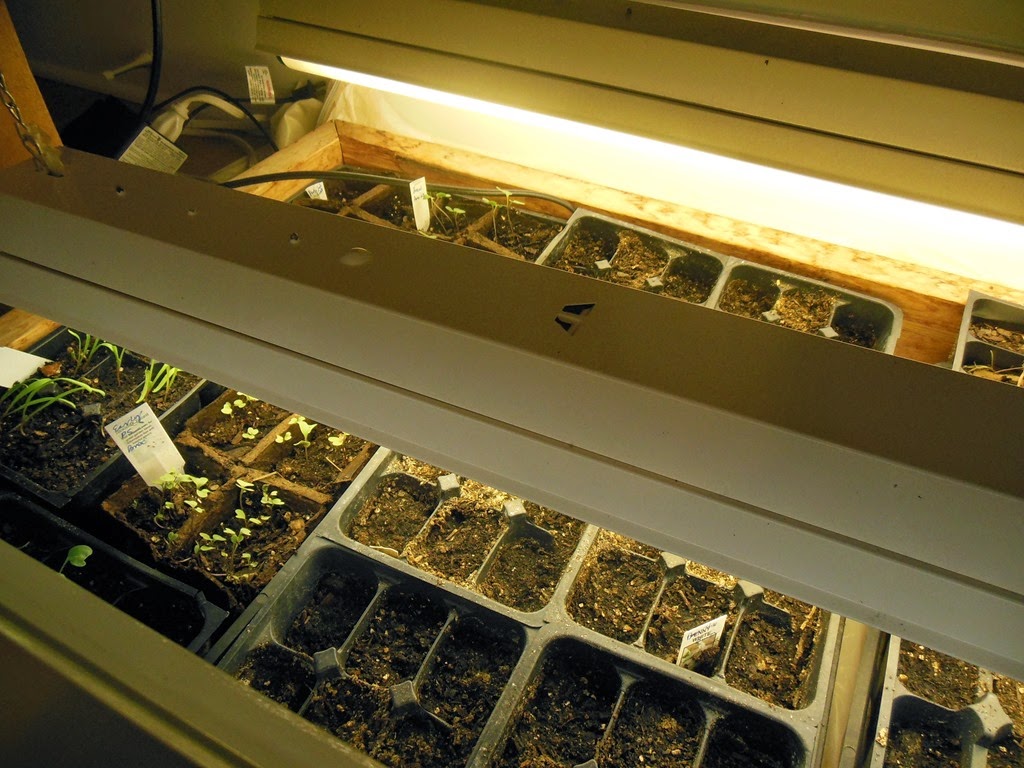
Even though it’s cold outside, I’ve been gardening indoors for a couple of weeks. My husband I made these lights many winters ago, and I use them every winter to grow seedlings. I don’t have a greenhouse, but these lights allow me to start my seedlings inside the house.

 |
| Seedlings grow inside my house |
 |
| I sowed seed in these pots last Thursday. |
To make grow lights, you will need lumber (figure out how much you will need based on your measurements), nails, and hooks from which you will hang the lights. We got three fluorescent shop lights to provide adequate illumination across the width of the seedling flats. I have never used the lights designed for plants, but my seedlings are growing too tall and leggy, so I have ordered some lights that have all the correct light waves needed by plants.
 |
| Kale seedlings strain to reach the lights |
To replicate my frame, make a frame wide enough to hold a nursery flat, or with an interior width of about 22 ½ inches. Make the frame long enough to accommodate the lights and four nursery flats; mine is about 4 feet, 3 inches long. Add two posts on each end and a beam down the middle of the frame, and make two arms across the beam to hold the lights. The arms are about 22 inches off the floor. Screw the hooks in at the appropriate place on the arms, and hang the lights from the chains. I use an old shower curtain under the grow lights to protect the floor from water, and I place the lights on a timer for 12 hours of light a day.

When I first plant the seeds, I hang the lights as low as possible; as the seedlings grow, I raise them so the lights are just above the foliage. Fluorescent lights give off very little heat so they will not scorch the foliage as long as they are not actually touching it. I use a heat mat, which is a waterproof pad that provides the seedlings with bottom heat to help them germinate quickly, under the seed trays if the weather outside is very cold. It helped my heat loving plants grow well, but it made my cold-tolerant plants, like broccoli, grow too quickly.
Grow lights make the process of starting seeds easier because I don’t have to move my seedlings around the house as the sun moves to make sure they have adequate exposure to light, and because I don’t have to take them outside for sun until the weather is consistently warm. Seedlings, like all baby creatures, appreciate consistent warmth, moisture, and food, and keeping the seedlings under grow lights helps them thrive. If you don’t want to build your own grow light, look online for premade versions.
If you want premade grow lights, light bulbs, or other seed starting supplies, consider purchasing these products: