Posted on

Plan your garden for the spring

Every winter, I enjoy planning my garden for the coming year.  Flipping through seed catalogs, perusing websites, and filling in labels on maps of the garden are lovely occupations for a cold winter day.

I keep records to make sure I don’t plant the tomatoes in the same spot year after year, preventing disease buildup and nutrient depletion.  I also create plans at the beginning of the year to ensure I have a space for every vegetable.

Nothing is worse (and I have done this) than planting the garden and realizing you forgot a critical crop.

This year, because I am attempting to grow vegetables for sale, my planning has become even more complex.  I created some basic documents that I print from my computer and fill in with a pencil and highlighter.  The photo below is of one of my first charts.img_3806

Across the top are dates (I chose Monday) in intervals of a week, and along the side I wrote the name of the crop.  From my seed packets and seed catalogs, I determine the days to maturity.

Some days to maturity are based on the date from transplant.  Others, like turnips, are based on the date from direct seeding.  I plan to write a post about understanding dates to maturity soon, so check back with me.

My farmers’ market opens on May 8, and I want to have plenty of vegetables ready for the market.  May 6 is the Monday of that week, so I marked that date in orange highlighter, then counted back in yellow highlighter to the date I needed to sow the seed to have the plant mature on May 6.

I have made this chart available to you for free as a document you may download, edit, and print by clicking here.  It’s very low-tech, and I know other farmers and the Excel-savvy folks do a more sophisticated plan, but if a pencil and a highlighter makes you happy, please use mine.  It is on two sheets of paper, so you will need to tape it together to make a sheet including all the dates.  Get some white-out, because you will need it when you incorrectly count the dates.

‘Polbig’ tomato will be an experiment in the hoophouse.  I am writing this on January 29, and I sowed seed for the ‘Polbig’ tomato and the ‘Lunchbox’ pepper today.  I will plant my main season tomato crops on March 11 to get them out into the garden at a time when the risk of frost has passed.  I am not a risk taker by nature, and I learned through experience and damaged tomato plants to not push the season.  I’ll provide these tomatoes with protection, and if they survive, they will be a bonus crop, not the main one.

I realized that using one chart for the entire garden was going to be too difficult to follow, so I copied the charts and made individual ones for each bed.  I have ten beds, and so I put the corresponding number on each chart.  Below is a much easier-to-use chart for bed 2.

I seed the broccoli in flats indoors on January 21, February 4, February 18, March 4, and March 18.  I will transplant them a corresponding five weeks later, and I will expect a harvest six weeks later.  This will give me a staggered harvest of broccoli into June.

img_3803

By the time the earliest plantings of broccoli are finished, it will be time to sow the seeds for beans directly into the soil.  They do not have to be transplanted, and they grow more quickly than broccoli, so I should be able to have a harvest of beans at one end of the bed while I am still picking broccoli from the other end.

Of course, this plan does not account for bad weather, insect damage, disease, or any other disaster that might befall my plants.  But, I have a plan.  Instead of wondering when I need to plant, or knowing when I need to plant and putting it off, I can consult my crop plan and sow the seeds on time.

Crop planning is sort of like lesson planning: your students may move more quickly or more slowly than you expect, or they might be sick a week, but at least you know what you are supposed to be doing in an ideal world.

By having this plan, I also know if a plant is not growing as quickly as the seed packet and the catalog promise.  I can search for the cause of the problem and try to remedy the problem.

In the photo below from 2002, when I had a 300 square foot garden in my first house in a subdivision (the neighbors thought I was insane to have such an “enormous” garden) I kept notes on a piece of notebook paper.  I love perusing my old garden journals.  I will have to share more of them in other posts.

img_3847

From year to year, I can also see if planting tomatoes early worked, or if it was a disaster.  The first and last frost dates have shifted by several weeks since I began gardening, and I need to adjust my planting dates based on these changes.  In 2002, I lived on an island off the coast of Charleston.  Frosts arrived late and left early, and the soil was rich and black.

I live near Columbia, 100 miles from the ocean now, and I don’t feel comfortable setting out my tomatoes until mid-to-late April.  Late frosts occur and kill the plants of the unwary gardener.  So, although I might set out some tender plants early, I won’t put in the entire garden until it is definitely safe.

Now that I am gardening more seriously, (and have access to the wonders of a home computer and a printer) I made charts to document my planting plan that I will also share with you. It is a basic document that you may edit.

By keeping these brief records, (and keeping toddler fingers from removing the plant labels so I no longer know which plant is which) I have already discovered that the ‘Sun King’ broccoli seed does not germinate with any reliability, and I have discarded the seed.  The broccoli seed I got at my neighborhood feed store, Sal’s Local Seed, is germinating correctly.  img_3795-1

When I started the process of trying to figure out succession planning, I searched the internet and found a few resources, but many of them were geared towards those unfortunate folks who live where it’s too cold to garden most of the winter.  I guess they can’t actually get outside and do any gardening for several months out of the year, so they have time to write gardening and create websites.
Grab your free downloads of the crop planning sheet and the crop note sheet and make planning your garden simple.

Posted on

The Broadfork: My new favorite tool

When we purchased the land on which the house and garden now sit nearly two years ago, it was covered with scraggly pine trees.  I found a penny dated 1962 on the ground, and based on what the neighbors tell me, the land was last in a functional pasture sometime in the 1960s.  In the intervening decades, pine trees and sweet gums took over the pasture and returned it to forest.

Clearing all those trees required a nice man with a bulldozer.  He knocked over the trees, pushed them into a pile, and burned them for us.  I am sure that burning giant piles of trees was not the most environmentally friendly method of disposal, but we had 2 acres of trees and roots to get rid of.  We briefly considered chipping them into mulch, but the cost was prohibitive and we would still have had more mulch than we could ever use.  Eventually it would have rotted, but in the interim it would have provided the perfect habitat for snakes and fire ants.

The nice man with the bulldozer brought in some topsoil to fill in a hole created when we had to borrow some soil to move up nearer the house to fill in a low spot.  After he brought in the soil,  he spread it where I asked, and then rode back and forth over the spot to make sure it was smooth, packing it down into something like concrete.  I describe the process in more detail in Beginnings.

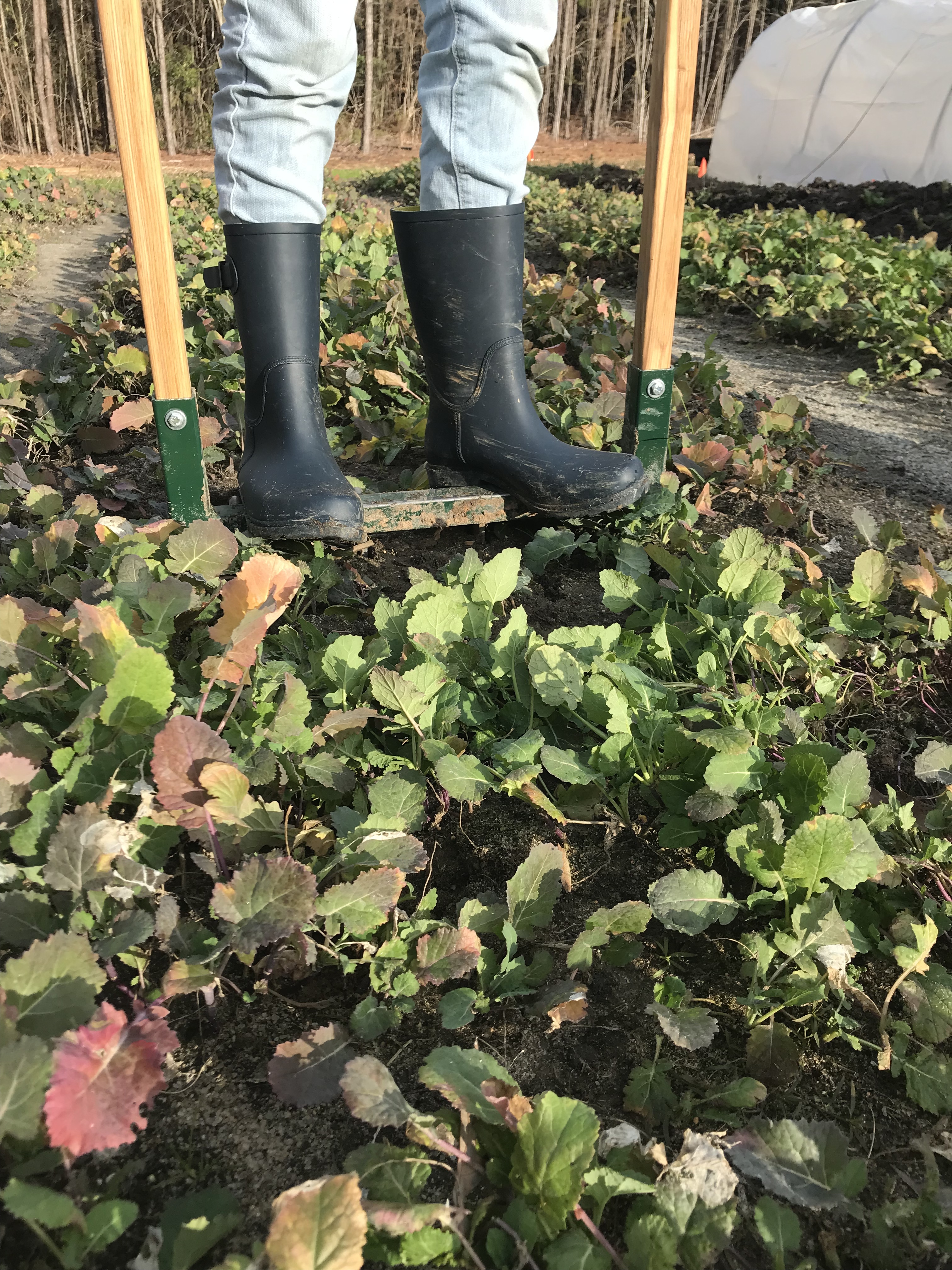
The landscaper did till the soil in my garden spot for me, but even after the tillage a hard layer of soil remained.  Although I dug the garden at my old house with a mattock and a spading fork, I needed something that would complete the job more quickly and with less effort.

I purchased a broadfork last week, from Johnny’s Seeds.  (I am not receiving any compensation for this post; I thought linking to their website might explain it better than I can).

img_3752
Broadfork sitting on top of the soil.

The blades are about 10 inches long.  My 12-year-old thought the work looked fun, and I let her help.

img_3753

She pressed the broadfork into the soil and then stood on it.  It entered the soil, but to put it into the full depth I had to stand on the broadfork and rock it back and forth.  Using the broadfork sort of reminds me of standing on a pogo-stick, although I don’t jump up and down but instead wiggle and rock it around.

img_3759

The blades of the broadfork break through the hardpan, and then I pull it back towards the ground.  I want to turn in this cover crop and do some more tillage of this soil, so I laid it back onto the ground.

img_3762

This loosens the soil about eight inches deep, and it is now easy to rake and to smooth the soil.  When I felt particularly energetic, I raked aside this now-fluffy soil and repeated the process of breaking up the soil and turning it over again.img_3764

To till the soil this deeply with any other method, I would have had to use a pickaxe.  My 12-year-old definitely could not have helped with that project.  I could have hired someone to till the soil, but that would have destroyed the beds I have created.  The tractor tires would have compacted much of the soil again.  I would also have had to wait until the soil was dry enough for a tractor or a tiller, and I don’t know when that might happen.

img_3765
At the top of the picture is soil that has been turned over and raked with the broadfork; at the bottom is an undisturbed bed.

I can take out the broadfork at almost any time to work the soil.  After I do the initial tillage of the soil, I won’t turn it over again.  Instead I will go through the beds, drive the broadfork into the soil, rock it back and forth a few inches, and move onto the next spot.

I used it in the lawn and the flowerbeds; those areas have also been victim to a bulldozer as well as the receptacle for piles of bricks and construction materials.  Water stands during rains in my flowerbeds, and I hope that the aeration with the broadfork will help.  I did not turn over the soil in my established beds or in my lawn, of course, I just rocked the blades back and forth to loosen and to aerate it.

For more on my work to transform my yard from a mud slick into a garden, visit Oh, this soil.  The best thing about using the broadfork is that there is nothing to break, no noise, and I can forgo any other workout on the day I use it.  And, if only she weighed a bit more, my 12-year-old could do the work.  It is satisfying and not overly difficult work.

Posted on 3 Comments

It’s time to prune shrubs and trees

Winters a few years ago were unseasonably warm, and on this blog I wrote, then, about flowers that were beginning to bud and to blossom out of season.  I was afraid that frost would come while they were in a vulnerable state and kill them.  All my plants are convinced that they should
remain dormant this winter, and I see no buds on plants that should be enjoying a winter rest.

Although I left this descendent of the  ‘Mahonia’ that my great aunt brought my grandmother from Oregon, and which my grandmother gave me when she dug it from the woods at her house at my old home when I sold it, I imagine it does have buds.  It is supposed to have buds this time of year, and honeybees visit the buds on warm days when it blooms in February. 

January and early February are a good time to prune trees and shrubs that do not bloom in the
spring.  Shrubs are dormant now, and although pruning spurs new growth in the warm months, it will not cause new growth during the winter.

On any shrub or tree, at any time of the year, remove dead, diseased, or broken branches.  To determine whether branches on deciduous trees or shrubs are dead or just dormant, bend the branch gently.  If the branch is pliable, it is alive and if it snaps, it is dead.  If the branch is too large to bend, scratch the bark with a fingernail; a live branch is green inside and a dead branch is gray or brown.

A favorite activity of landscapers this time of year is mauling crape myrtle trees and pruning otherwise naturally shaped shrubs into cubes.  People cut off the top branches of crape myrtle trees very short, so that the trees look like a slender pincushion with pins protruding off the top instead of enjoying the graceful, natural form of the tree.  

I pruned the crape myrtle tree at my own home by pruning out, to the junction with the branch, any crossing or dead branches, displaying the natural form of the tree.  Even without any foliage or flowers, it’s beautiful.

Below are examples of ‘Crape murder.’  Some hapless parking lot landscaper pruned off the top of these trees, causing them to sprout up many small branches because someone told him or her that pruning the tree this way would cause the tree to make more flowers.  More flowers will form, but I find that my tree gives me plenty of flowers anyway, and it isn’t heinous the rest of the year, either.


“Prune after bloom” is a good rule of thumb, so do not prune forsythia, hydrangeas, azaleas, and camellias, among other spring-blooming shrubs, until after they bloom.  If you prune them before they bloom, you will cut of the flower buds and will have to wait until next year for blossoms. 

Use hedge trimmers to shape boxwoods and hollies into squared-off shapes, if you
prefer it, but please do not prune azaleas, camellias, forsythia, loropetalum, and other shrubs with graceful, flowing branches into little squares or balls.  Flowering shrubs are much more
attractive, and easier to maintain, if you allow them to 
maintain their natural form. Reduce size by cutting off entire branches with loppers, not by giving them a haircut with hedge trimmers. 

If you must prune shrubs several times a year to keep them under control, the repeated chore is a sign that you have a shrub in the wrong place.  It may be too big for its spot, or it may have an unruly nature in a place where you would like a neat shrub.  Perhaps both you and the shrub would be happier if you removed it and put something more appropriate to the space in
its place.  

I butchered this loropetalum, above, because it was about to extend into my driveway.  Although I paid extra money for the dwarf version of the shrub, no one told the shrub it was supposed to stay small.  I eventually dug up this shrub and replaced it with another shrub of an appropriate size.

At my new home, I chose shrubs that are slow-growing, unlike loropetalum, that will remain at the correct size.   I also gave them plenty of room in which to grow.  The landscape around the new house looks sparse now, but in ten years I hope I will only need to give the shrubs a haircut occasionally.
Head out to the garden and prune your shrubs and refresh your mulch while the snakes, chiggers, and mosquitoes are dormant.  Isn’t working outside more pleasant in January than in June?
Posted on

Hoop House Completion

The weather has been sunny for the past few days, thank God, and I have been able to finish the hoop house.  In this post I describe the first day of construction.

My hoop house is small and isn’t a permanent structure, but it should protect my vegetables from rain, wind, cold, and even heat.  It is also something you can make in your own garden with easily available materials from a home center or online.

Here is a photo of the finished hoop house, with Phoenix kitten looking on.  He hopes I make a lovely winter habitat to attract lizards and other fun things he can catch.  I draped the plastic over the entire structure, with the help of my children.  I could have done it alone, if I had sandbags ready to weight down the plastic.  The day I completed this project was breezy, which made things interesting but manageable.

img_3700
Finished hoop house with kitten.

At the ends of the structure are sandbags.  The professionals with large tunnels pull the plastic tight and tie it to a stake, but the sandbags are sufficient for my needs.  img_3698

You can see the conduit inserted on top of the rebar.  I tied rope to the rebar and zig-zagged it over the top of the hoop house to hold down the plastic.  I will pull up the plastic, and then pull the rope tight to hold it up for ventilation or to get inside to work.

I cannot stand up in the structure; it is only about 4 feet tall at the apex.  I also got some clips that fit on the conduit to help hold it up and to hold it in place across the top.

To put the rope on top, I had to just play with it to figure out how it worked.  Here’s what I discovered:  I tied the rope to the rebar, not to the conduit, because then the rope will slip up with the conduit when it moves.  I tossed it diagonally across the hoop house and fished it out of the mud on the other side, and I wrapped it around the rebar on that side.

I continued this process down the hoop house with one rope (I needed one about 60 feet long, maybe a bit less, to go the length of my 35 foot long hoophouse).  Then, with another rope, also about 60 feet long, I started on the other side of the first hoop and zig-zagged my way down the hoop house.  My hoop house is 35 feet long.  If you double the length of the hoop house, which would be 70 feet, and then double that for the two ropes, you will probably have enough rope.

At the opposite end from where I began, I ended up with two ropes.  I can pull them tight to hold up the plastic when I raise it to ventilate the hoophouse, and I can relax it to let down the plastic.  The plastic-moving process isn’t as simple as it sounds: I will have to go hoop by hoop to raise and to secure the plastic.  img_3691

I am keeping the memory of this beautiful spinach, harvested from my cold frame, in my mind as I try to figure out how to construct and to manage all of this.  I hope to have an entire hoop house of this in a few months.

To see my first day of hoop house construction, in which I put up the conduit hoops, go here.


Posted on

Hoop House Construction, Day 1

This was the best I could do for a hoop house until I began my new project.  The flimsy wire did the job, sort of, but it was very difficult to work with to move the plastic when I needed to access the plants and to ventilate the space on warm days.  My broccoli appreciated the cover I provided for it earlier in the fall when I put shade cloth on it to protect it from the heat, however.

img_3671.jpg

To make the hoop house, I drove rebar stakes into the ground five feet apart and four feet across from each other.  Then I slid a piece of 1/2 inch plastic conduit, available in the electrical aisle, onto one post and bent it over onto the other post.

I continued this process down the bed, to make a bed 4 feet wide by 35 feet long.  PVC, or polyvinyl chloride, the plastic that makes the conduit, reacts with polyethylene in the plastic with which I will cover the hoops, and causes it to deteriorate.  I spray painted the hoops to prevent the chemical reaction, and I will also add felt tape/weatherstripping to the conduit to provide further protection.

img_3668
Tunnel of hoops completed

I was satisfied with the paint job, but my 12 year old came out to see what I was doing and decided to touch up some spots I had missed.  Thrilled with her first opportunity to use spray paint, she made sure the hoops were painted thoroughly.  I received a phone call during all of this, and didn’t really pay attention to what she was doing, and so I got a rainbow.  At least we used up several partial cans of spray paint that had been cluttering the garage for years.img_3669

The nine year old, an obsessed Clemson fan, came out and noticed all the purple, and asked if I was going to use some orange.  I told her I had no orange and that we were DONE painting.

Last night, I went to the store to purchase some more conduit and supplies to make roll-up sides on the hoop house.  I had to buy more spray paint and at first I chose a sedate forest green that would blend in with the garden.  I imagined her joy at a Clemson hoop house, and I put it back and chose orange instead.

If it ever stops raining, I will paint the other conduit, add the plastic, and begin planting.  Right now I don’t need to protect my plants from the cold but I do need to keep off the constant rain.

These salad greens in my cold frame are absolutely gorgeous, and I plan to have a similar harvest in my hoop house.  I already have some baby spinach plants that are in the open garden, being battered by the rain, and I will transplant them into the hoop house where, I hope, they will be as happy as these plants.

img_3676