I haven’t written an update in a couple of weeks! Things have been busy here with farming and with life. The girls enjoyed taking their friends to a tour of the pigs during their birthday party, and I told the children, to the horror of some, that these pigs would be dinner. There were no vegetarians present, and so I reminded them that the bacon they enjoyed came from a pig, and it was probably a pig who was confined to a building who never got to enjoy the outdoors.
In the garden, pollen season has arrived and everything has decided it is time to grow. I am experimenting with growing tomatoes in the hoophouse this year. I set them out inside the tunnel in early March.
Our temperatures have remained above freezing, but even temperatures below 40 will damage the plants, and so on the colder nights I have tucked them under another layer of rowcover inside the hoophouse.
They seem to be reasonably happy in there, and I hope to be able to have an early crop of tomatoes. The soil in the entire garden is still pretty rough. I also have trouble with water draining into the garden area from the top of the hill.
The soil is a work in progress: a little over a year ago this garden site was a pine forest and it has suffered the ravages of a bulldozer. The raised beds have saved my garden this winter, and I can protect the soil in the beds from further compaction by my feet. It will get better, but having to use a tool to get through a dry crust on top of the soil is pretty discouraging when I could open rows with my fingers in my old garden.
Water collects in the ditches between the raised beds.
I have faith that good treatment and lots of organic matter will bring this soil to life, although I won’t put down heavy layers of mulch the way I did in my old garden because it makes a great habitat for snakes. I will have to tell you my snake story later.
We are privileged to bring livestock back to this property. When we purchased the land, it was a neglected portion of a family farm that had been in the same family since the late 1700s. We are honored to be the first people to own the land after the original family obtained it in, I presume, a land grant.
I can only imagine how many hoofed animals traversed this land over the centuries. Milk cows, beef cows, and pigs must have made their homes here. Fences made of stone outline the property in places. I am told that the area on which we built our house was last a cow pasture back in the 1930s. The area where the pigs reside was in corn and other row crops at least in the 1960s, but the land has been vacant for decades. Below is a view of the field towards the road (the house in the distance belongs to the neighbors).
Somehow I never imagined myself acquiring pigs in the rain, but given the past winter we had, I guess it shouldn’t have come as a surprise. The night before I went to get them, I listened to the rain pounding on our metal roof and watched it pouring off the porch roof in sheets, and I prayed I wouldn’t get stuck in the mud.
I do not own a big truck; the mom SUV had to do the job. I did get stuck in the mud while pulling the trailer out of the farm, but we got on the road without having to call a tow truck, and made it back home.
I greatly appreciate the help of my parents for this crazy venture. My mother kept the children and even took them to a birthday party while my husband was on a work trip.
My father, who made this trailer for his cattle out of reused pieces of sheet metal and angle iron he salvaged over the years from other peoples’ discards, met me at Six Oaks Farm early Saturday morning, with the trailer. He no longer has cattle, but he had them for nearly all my life and taught me everything I know about herding animals.
My father saves all metal, and during my scrounging for materials with which I could construct pig shelters, he resurrected this red hood from a 1987 Nissan Sentra. It belonged to the car my sister drove briefly in college before a deer totaled it for the second time and had lay propped in the barn since, by my calculations, 1996. It made an excellent corral side.
Some weeks after I acquired chickens, I realized that all the sayings about chickens: “Bird brain,” “Going to bed with the chickens,” and “Don’t put all your eggs in one basket (thank you toddler),” are true.
It took me about 2 minutes of pig unloading to determine that the one pig idiom I can now recall, “Pigheaded,” is entirely accurate.
First we tried to be nice by sprinkling food in a little line. No interest from the piggies. We talked to them about the nice green grass. I coaxed them as I would a child or a dog. Not having it.
I began to have flashbacks from every cattle-moving experience of my entire life which, as I think on it, have been numerous. There was the time(s) the cows were on the side of the highway when we came home from school, the times we found cow pies in the yard and had to find their source, the many times my father loaded cows onto the trailer and we had to help by yelling and running behind them.
There was the time a terrified Charolais cow stood up on her hind legs and crashed down the sides of the loading chute with her body weight. I remember my father standing behind the cattle, or, more safely, hanging off the side of the loading chute, with a cattle prod to encourage movement from the slow ones. We were afraid they would turn around (they did many times) and trample him (he was agile and got out of the way).
He never had any trouble getting them OFF the trailer, and of all my worries about pigs, getting them off was not one of them.
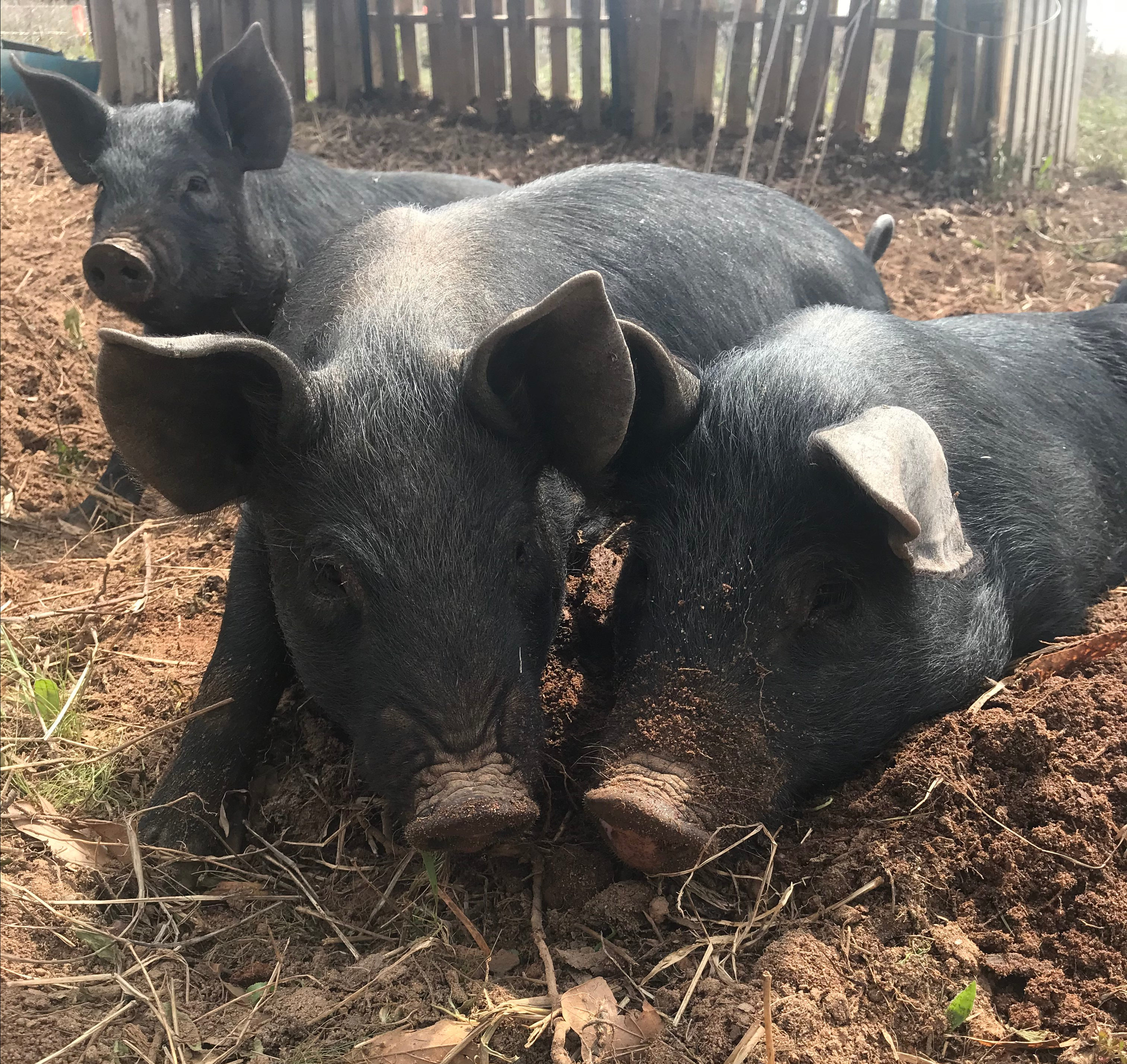
These pigs refused to move. They are 50-60 pounds of solid muscle. About 15 inches tall and 2 1/2 feet long, they pack that weight into a small space that also contains hooves and teeth.
It is now my time to get into the trailer and for my father to prod and encourage them from the outside. We used my father’s walking stick for a bit of leverage.
I grabbed the smallest one around the middle and dragged her, as she squealed, towards the ramp. The wood was slick and I fell to my knees and nearly slid down the ramp on top of her, but we got her off. She ran into the pen and began eating as if it was all her idea.
I don’t remember exactly how we got the second one off, but the third and fourth ones just sat down on the trailer and glared at me, in very much the same way my dachshund, Sterling, used to sit down on the ground and refuse to move when he was tired of walking.
A toddler having a tantrum because he doesn’t want to leave, and becomes limp and lifeless on the floor, has nothing on these pigs. For one thing, your average toddler weighs about half of what the pigs do, and for another, presumably he loves you and trusts you. They flattened themselves onto the trailer and, at times, seemed to be considering a nap.
We kept prying them forward, pulling them under the armpits and by the legs, and finally got them all off. It was hilarious, excellent aerobic and upper body exercise for me, and I only wish someone else had been there to film it for your entertainment. At least they aren’t (yet) big enough to trample me, and I do have confidence that I can make friends with them in time.
They have been busy over the past two days. I am not certain what I want to do with this field, but I might want to put vegetables or flowers to sell at market in this area. I am happy with the destruction the pigs are wreaking on my field, and they are happy digging to China in search of food. I know I don’t want it covered with sweet gums and briars, and they will take care of those problems for me.
They will leave this pen in a few days to live on pasture and in the woods, much as any pig ancestors on this land lived. Perhaps they will eat acorns from the same tree a pig ate from 100 years ago. They will have one bad day in their lives, the day they go to the slaughterhouse, but for the rest of their approximately six months with me, they will enjoy life outdoors rooting in the dirt and searching for goodies.
Sal’s Garden Boxes are monthly containers of delight that Sallie Sharpe, a seventh-generation homesteader from the Blythewood area, creates to help new gardeners know what to plant when, and to make gardening easier for experienced gardeners.
The November box contained a mix of succulent seed and cute containers in which to plant it indoors, garlic to plant in the garden, a pair of earrings from a local artisan, and seasonal Thanksgiving decorations.
I love Sal’s attention to detail. Every item in the boxes coordinates with the rest of the contents.
Here is February’s box. Potatoes and onions to plant in the spring garden, all enclosed in a pink bag to continue the Valentine’s Day theme.
Potato tubers are in a cellophane bag covered with hearts, and the carrot package has a multicolored tag describing the name. It inspired me to plant them in the garden immediately. (Well when it stopped raining for a bit anyway!)
Even the directions for planting the garden are beautiful. No boring piece of copy paper for Sal!




 Here is February’s box. Potatoes and onions to plant in the spring garden, all enclosed in a pink bag to continue the Valentine’s Day theme.

