Posted on 2 Comments

Spring is keeping me busy

I haven’t written an update in a couple of weeks!  Things have been busy here with farming and with life.  The girls enjoyed taking their friends to a tour of the pigs during their birthday party, and I told the children, to the horror of some, that these pigs would be dinner.  There were no vegetarians present, and so I reminded them that the bacon they enjoyed came from a pig, and it was probably a pig who was confined to a building who never got to enjoy the outdoors.

img_4107

In the garden, pollen season has arrived and everything has decided it is time to grow.  I am experimenting with growing tomatoes in the hoophouse this year.  I set them out inside the tunnel in early March.  img_4152

Our temperatures have remained above freezing, but even temperatures below 40 will damage the plants, and so on the colder nights I have tucked them under another layer of rowcover inside the hoophouse.  img_4158

They seem to be reasonably happy in there, and I hope to be able to have an early crop of tomatoes.  The soil in the entire garden is still pretty rough.  I also have trouble with water draining into the garden area from the top of the hill.  

The soil is a work in progress: a little over a year ago this garden site was a pine forest and it has suffered the ravages of a bulldozer.  The raised beds have saved my garden this winter, and I can protect the soil in the beds from further compaction by my feet.  It will get better, but having to use a tool to get through a dry crust on top of the soil is pretty discouraging when I could open rows with my fingers in my old garden. 

img_4154
Water collects in the ditches between the raised beds.

I have faith that good treatment and lots of organic matter will bring this soil to life, although I won’t put down heavy layers of mulch the way I did in my old garden because it makes a great habitat for snakes.  I will have to tell you my snake story later.


Posted on

The Broadfork: My new favorite tool

When we purchased the land on which the house and garden now sit nearly two years ago, it was covered with scraggly pine trees.  I found a penny dated 1962 on the ground, and based on what the neighbors tell me, the land was last in a functional pasture sometime in the 1960s.  In the intervening decades, pine trees and sweet gums took over the pasture and returned it to forest.

Clearing all those trees required a nice man with a bulldozer.  He knocked over the trees, pushed them into a pile, and burned them for us.  I am sure that burning giant piles of trees was not the most environmentally friendly method of disposal, but we had 2 acres of trees and roots to get rid of.  We briefly considered chipping them into mulch, but the cost was prohibitive and we would still have had more mulch than we could ever use.  Eventually it would have rotted, but in the interim it would have provided the perfect habitat for snakes and fire ants.

The nice man with the bulldozer brought in some topsoil to fill in a hole created when we had to borrow some soil to move up nearer the house to fill in a low spot.  After he brought in the soil,  he spread it where I asked, and then rode back and forth over the spot to make sure it was smooth, packing it down into something like concrete.  I describe the process in more detail in Beginnings.

The landscaper did till the soil in my garden spot for me, but even after the tillage a hard layer of soil remained.  Although I dug the garden at my old house with a mattock and a spading fork, I needed something that would complete the job more quickly and with less effort.

I purchased a broadfork last week, from Johnny’s Seeds.  (I am not receiving any compensation for this post; I thought linking to their website might explain it better than I can).

img_3752
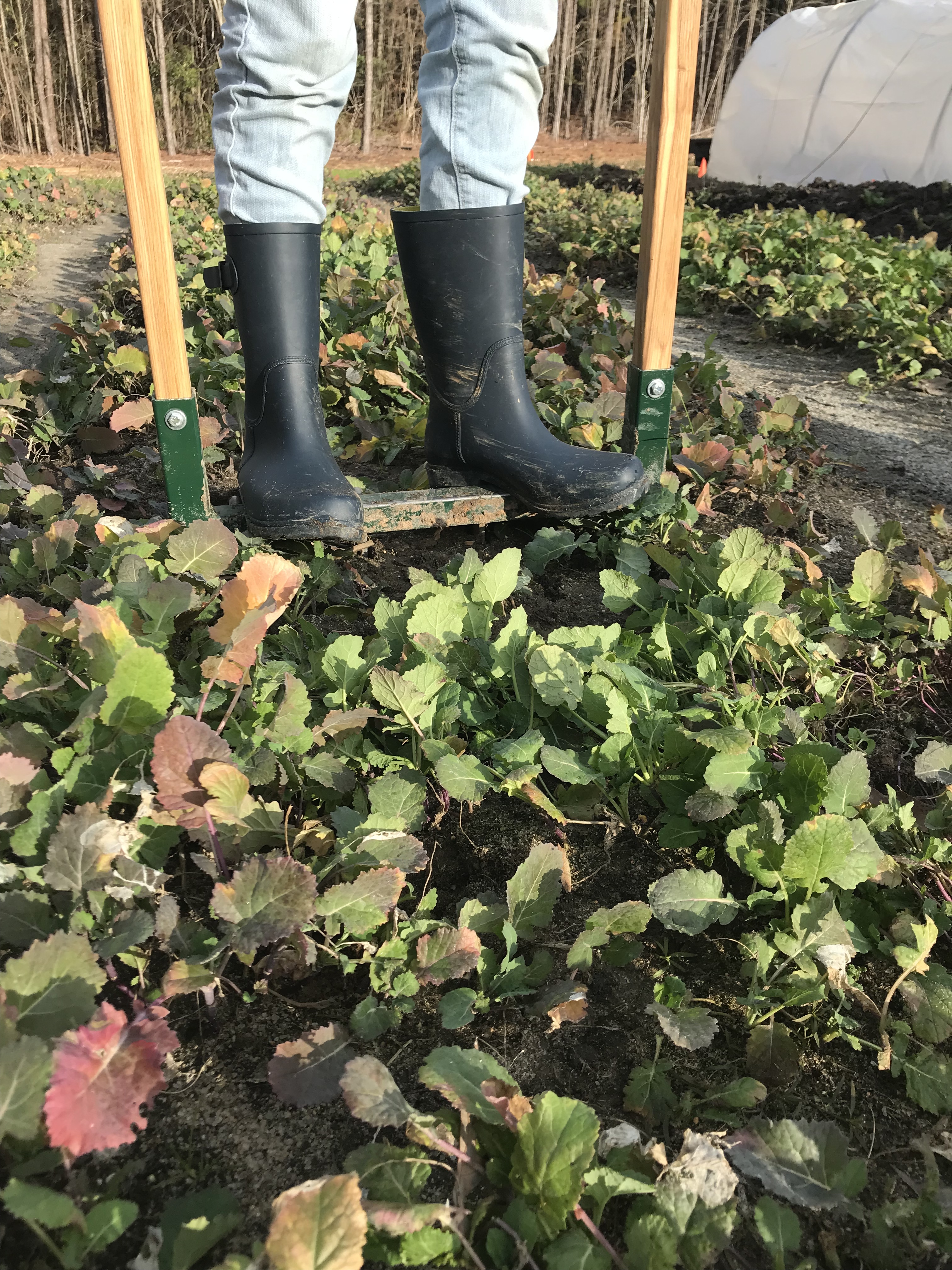
Broadfork sitting on top of the soil.

The blades are about 10 inches long.  My 12-year-old thought the work looked fun, and I let her help.

img_3753

She pressed the broadfork into the soil and then stood on it.  It entered the soil, but to put it into the full depth I had to stand on the broadfork and rock it back and forth.  Using the broadfork sort of reminds me of standing on a pogo-stick, although I don’t jump up and down but instead wiggle and rock it around.

img_3759

The blades of the broadfork break through the hardpan, and then I pull it back towards the ground.  I want to turn in this cover crop and do some more tillage of this soil, so I laid it back onto the ground.

img_3762

This loosens the soil about eight inches deep, and it is now easy to rake and to smooth the soil.  When I felt particularly energetic, I raked aside this now-fluffy soil and repeated the process of breaking up the soil and turning it over again.img_3764

To till the soil this deeply with any other method, I would have had to use a pickaxe.  My 12-year-old definitely could not have helped with that project.  I could have hired someone to till the soil, but that would have destroyed the beds I have created.  The tractor tires would have compacted much of the soil again.  I would also have had to wait until the soil was dry enough for a tractor or a tiller, and I don’t know when that might happen.

img_3765
At the top of the picture is soil that has been turned over and raked with the broadfork; at the bottom is an undisturbed bed.

I can take out the broadfork at almost any time to work the soil.  After I do the initial tillage of the soil, I won’t turn it over again.  Instead I will go through the beds, drive the broadfork into the soil, rock it back and forth a few inches, and move onto the next spot.

I used it in the lawn and the flowerbeds; those areas have also been victim to a bulldozer as well as the receptacle for piles of bricks and construction materials.  Water stands during rains in my flowerbeds, and I hope that the aeration with the broadfork will help.  I did not turn over the soil in my established beds or in my lawn, of course, I just rocked the blades back and forth to loosen and to aerate it.

For more on my work to transform my yard from a mud slick into a garden, visit Oh, this soil.  The best thing about using the broadfork is that there is nothing to break, no noise, and I can forgo any other workout on the day I use it.  And, if only she weighed a bit more, my 12-year-old could do the work.  It is satisfying and not overly difficult work.

Posted on

Hoop House Completion

The weather has been sunny for the past few days, thank God, and I have been able to finish the hoop house.  In this post I describe the first day of construction.

My hoop house is small and isn’t a permanent structure, but it should protect my vegetables from rain, wind, cold, and even heat.  It is also something you can make in your own garden with easily available materials from a home center or online.

Here is a photo of the finished hoop house, with Phoenix kitten looking on.  He hopes I make a lovely winter habitat to attract lizards and other fun things he can catch.  I draped the plastic over the entire structure, with the help of my children.  I could have done it alone, if I had sandbags ready to weight down the plastic.  The day I completed this project was breezy, which made things interesting but manageable.

img_3700
Finished hoop house with kitten.

At the ends of the structure are sandbags.  The professionals with large tunnels pull the plastic tight and tie it to a stake, but the sandbags are sufficient for my needs.  img_3698

You can see the conduit inserted on top of the rebar.  I tied rope to the rebar and zig-zagged it over the top of the hoop house to hold down the plastic.  I will pull up the plastic, and then pull the rope tight to hold it up for ventilation or to get inside to work.

I cannot stand up in the structure; it is only about 4 feet tall at the apex.  I also got some clips that fit on the conduit to help hold it up and to hold it in place across the top.

To put the rope on top, I had to just play with it to figure out how it worked.  Here’s what I discovered:  I tied the rope to the rebar, not to the conduit, because then the rope will slip up with the conduit when it moves.  I tossed it diagonally across the hoop house and fished it out of the mud on the other side, and I wrapped it around the rebar on that side.

I continued this process down the hoop house with one rope (I needed one about 60 feet long, maybe a bit less, to go the length of my 35 foot long hoophouse).  Then, with another rope, also about 60 feet long, I started on the other side of the first hoop and zig-zagged my way down the hoop house.  My hoop house is 35 feet long.  If you double the length of the hoop house, which would be 70 feet, and then double that for the two ropes, you will probably have enough rope.

At the opposite end from where I began, I ended up with two ropes.  I can pull them tight to hold up the plastic when I raise it to ventilate the hoophouse, and I can relax it to let down the plastic.  The plastic-moving process isn’t as simple as it sounds: I will have to go hoop by hoop to raise and to secure the plastic.  img_3691

I am keeping the memory of this beautiful spinach, harvested from my cold frame, in my mind as I try to figure out how to construct and to manage all of this.  I hope to have an entire hoop house of this in a few months.

To see my first day of hoop house construction, in which I put up the conduit hoops, go here.


Posted on

New Year’s Resolutions in the Garden

Making New Year’s Resolutions for the garden is much more fun than making resolutions in my personal life.  No need to give up the cake in the garden; the exercise I get while working in the garden gives me an excuse to eat cake! 

As 2018 leaves us, I give you a list to pursue for next year.  Some of these resolutions I have already achieved through many years of work, and some of them I continue to pursue, but I will put them all here in case you need some gardening inspiration.

1. Don’t let any weeds go to seed in the garden again, ever.

This is a big one, I know. But every time you see the fronds of the crabgrass plant about to mature enough to spread seeds or the tiny flowers of henbit appear, pull up the plant. Clip off the seed heads and throw them in the garbage if you can’t manage pulling up the weeds. Get my ebook on weed control for more ideas to stop the weeds. 

There is a saying, “One year’s seeds makes seven years’ weeds,” and this is true. One mature crabgrass plant can shower 150,000 seeds onto your garden, and so pulling up that one crabgrass plant before it goes to seed can keep you from dealing with 150,000 crabgrass plants in the future.

2. Hoe the soil early and often, sort of like unscrupulous politicians encourage voting.

Don’t wait until the weeds are six inches tall to deal with them. Walk through the garden when the weeds are very tiny, or even before they appear, and lightly disturb the soil with a hoe. This will kill all the weeds and those that are about to appear, with very little effort from you.

Try to do this on the early morning of a dry, hot, day and the weeds will shrivel away in moments.

3. Consider applying mulch to the garden if all this hoeing sounds like too much work.

If you apply it heavily enough, weeds will stay away all season. Consider using heavy-weight, professional-grade landscape fabric if applying mulch made of organic materials sounds like too much work.

Don’t bother with the landscape fabric sold in home centers; it will deteriorate within a few months. I don’t care what it says on the box.

4. Lay out permanent beds in the vegetable garden.

Cultivate this area, and do not walk in it. Leave the paths between the beds for foot and wheelbarrow traffic. Reduce the cost of fertilizers and compost by applying the material only in the beds instead of broadcasting it over the entire garden.

5. Eliminate chemical fertilizers from your garden.

Feed the soil, and the soil will feed the plants. Add organic matter like leaves or straw, compost, grass clippings, alfalfa meal, blood meal, bone meal, or a general organic fertilizer to the garden. Purchase worms from a bait store or online, and add them to the garden if you don’t have any. Chemical fertilizers damage beneficial soil microbes and add unnecessary salt to the soil. Encourage soil life, and your plants will thrive.

6. Get a soil test every year and follow the recommendations.

Ask for organic fertilizer recommendations in the test results. The soil in my garden is deficient in phosphorus, and isn’t very high in anything. It’s the first year on new ground. Because I know that it lacks phosphorus, I can spend my money on adding phosphorus instead of spreading around the money on all of the soil nutrients. Soil test results also indicate whether or not the garden needs lime, and how much lime it needs.

7. Plan ahead for irrigation.

Nothing needs water in my garden this rainy winter, but July will arrive, and instead of dragging around hoses and using sprinklers that water irregularly, I will set up drip irrigation. Drip irrigation saves water and also reduces disease because it doesn’t wet the plant’s foliage.

8. Try something new.

Whether it’s a new flower or vegetable, starting plants from seeds, learning to root cuttings, managing the weeds differently or using season-extension techniques, begin a new project in the garden. My project will be constructing a low tunnel or hoop house in the garden from plastic conduit and greenhouse plastic.

I will grow lettuces and other crops that benefit from a little warm weather and protection, and then in the summer I will cover it with shade cloth to protect plants from the scorching sun. I’ll update you on this project as it progresses; I plan to begin it this coming week!

Posted on 2 Comments

Rowcover laying is difficult enough…then just add kittens!

Our house is new, and so many people have been to the house to paint, complete projects, and work on things.  We have had to lock the kittens in the house so they don’t “help” the painters.  The kittens, rescued last summer from the Calico garden and tamed by my three children into loving creatures who seek the attention of people, behave more like dogs than any cat I have ever known.  They do seem to appreciate our rescue of them from the wild.

A couple of days ago, I worked in the garden putting down row cover preparing the plants for the upcoming cold weather.  Ashes and Phoenix chased me into the woods, climbing trees and stalking each other among tree trunks, when I entered to rake some leaves to put on the new asparagus and garlic beds, and they attacked my ankles as they hid in the cover crops.

As I spread the row cover over the broccoli, spinach, and kale plants to protect them from the cold weather, as well as the rain and the wind, the cats wanted to “help” me.  They are like helping children, in that their help is often a hindrance.  Here is a video of them not helping at all, but having a great time playing in the new tunnels I created with the row cover.

I created the structure of the tunnels by cutting some 12 gauge wire, available at home centers in the chain link fencing section, into hoops about 40 inches long.  If you cut them too long, they will flop over, and if they are too short, there will not be enough room for the mature height of the plants.

Then I draped the row cover over the hoops, and I secured it with clothes pins and with metal posts, stones, and whatever else I could find.  I need to work on more efficient ways to weight down the row cover.  You cannot cut the wire with ordinary wire cutters, although I have read that you can score them with a metal cutting tool and snap them.  I purchased bolt cutters  to make the job easier.

Row cover protects plants from freezing temperatures, and, depending on the weight of the fabric, may increase the air temperature around the plants by several degrees.  The fabric keeps torrential rain off of the plants, and it also prevents the desiccating effects of winter winds.  It almost gives your plants a mini-greenhouse environment similar to that of a cold frame, but the fabric allows enough heat to escape so you don’t have to worry about the odd sunny day roasting your plants the way you have to if they are covered in plastic.

Use some season extension techniques and harvest vegetables all year long!