Posted on

Conquering the Weeds

“The weeds are taking over!” is normally my lament this time of year, although if you are in South Carolina right now, nothing grows when the temperatures are 95 to 100 degrees and there is no rain.

After studying the practices of organic farmers and observing the weeds in my own garden, I wrote this ebook about maintaining a (nearly) weed-free garden using organic methods.  Click here to view it on Amazon…it’s free for Kindle Unlimited subscribers.

This year, the weeds are not overtaking me.  Thanks to following the practices in my book, I can, for the first time ever, say that I do not have a problem with weeds in the garden.  I do not spend hours weeding, and instead of battling 50 feet of crabgrass with a hoe, I walk among my plants, pull out the occasional weed, (disposing of any going to seed in the trash), and otherwise enjoy the garden.

Posted on 2 Comments

Spring is keeping me busy

I haven’t written an update in a couple of weeks!  Things have been busy here with farming and with life.  The girls enjoyed taking their friends to a tour of the pigs during their birthday party, and I told the children, to the horror of some, that these pigs would be dinner.  There were no vegetarians present, and so I reminded them that the bacon they enjoyed came from a pig, and it was probably a pig who was confined to a building who never got to enjoy the outdoors.

img_4107

In the garden, pollen season has arrived and everything has decided it is time to grow.  I am experimenting with growing tomatoes in the hoophouse this year.  I set them out inside the tunnel in early March.  img_4152

Our temperatures have remained above freezing, but even temperatures below 40 will damage the plants, and so on the colder nights I have tucked them under another layer of rowcover inside the hoophouse.  img_4158

They seem to be reasonably happy in there, and I hope to be able to have an early crop of tomatoes.  The soil in the entire garden is still pretty rough.  I also have trouble with water draining into the garden area from the top of the hill.  

The soil is a work in progress: a little over a year ago this garden site was a pine forest and it has suffered the ravages of a bulldozer.  The raised beds have saved my garden this winter, and I can protect the soil in the beds from further compaction by my feet.  It will get better, but having to use a tool to get through a dry crust on top of the soil is pretty discouraging when I could open rows with my fingers in my old garden. 

img_4154
Water collects in the ditches between the raised beds.

I have faith that good treatment and lots of organic matter will bring this soil to life, although I won’t put down heavy layers of mulch the way I did in my old garden because it makes a great habitat for snakes.  I will have to tell you my snake story later.


Posted on

New Year’s Resolutions in the Garden

Making New Year’s Resolutions for the garden is much more fun than making resolutions in my personal life.  No need to give up the cake in the garden; the exercise I get while working in the garden gives me an excuse to eat cake! 

As 2018 leaves us, I give you a list to pursue for next year.  Some of these resolutions I have already achieved through many years of work, and some of them I continue to pursue, but I will put them all here in case you need some gardening inspiration.

1. Don’t let any weeds go to seed in the garden again, ever.

This is a big one, I know. But every time you see the fronds of the crabgrass plant about to mature enough to spread seeds or the tiny flowers of henbit appear, pull up the plant. Clip off the seed heads and throw them in the garbage if you can’t manage pulling up the weeds. Get my ebook on weed control for more ideas to stop the weeds. 

There is a saying, “One year’s seeds makes seven years’ weeds,” and this is true. One mature crabgrass plant can shower 150,000 seeds onto your garden, and so pulling up that one crabgrass plant before it goes to seed can keep you from dealing with 150,000 crabgrass plants in the future.

2. Hoe the soil early and often, sort of like unscrupulous politicians encourage voting.

Don’t wait until the weeds are six inches tall to deal with them. Walk through the garden when the weeds are very tiny, or even before they appear, and lightly disturb the soil with a hoe. This will kill all the weeds and those that are about to appear, with very little effort from you.

Try to do this on the early morning of a dry, hot, day and the weeds will shrivel away in moments.

3. Consider applying mulch to the garden if all this hoeing sounds like too much work.

If you apply it heavily enough, weeds will stay away all season. Consider using heavy-weight, professional-grade landscape fabric if applying mulch made of organic materials sounds like too much work.

Don’t bother with the landscape fabric sold in home centers; it will deteriorate within a few months. I don’t care what it says on the box.

4. Lay out permanent beds in the vegetable garden.

Cultivate this area, and do not walk in it. Leave the paths between the beds for foot and wheelbarrow traffic. Reduce the cost of fertilizers and compost by applying the material only in the beds instead of broadcasting it over the entire garden.

5. Eliminate chemical fertilizers from your garden.

Feed the soil, and the soil will feed the plants. Add organic matter like leaves or straw, compost, grass clippings, alfalfa meal, blood meal, bone meal, or a general organic fertilizer to the garden. Purchase worms from a bait store or online, and add them to the garden if you don’t have any. Chemical fertilizers damage beneficial soil microbes and add unnecessary salt to the soil. Encourage soil life, and your plants will thrive.

6. Get a soil test every year and follow the recommendations.

Ask for organic fertilizer recommendations in the test results. The soil in my garden is deficient in phosphorus, and isn’t very high in anything. It’s the first year on new ground. Because I know that it lacks phosphorus, I can spend my money on adding phosphorus instead of spreading around the money on all of the soil nutrients. Soil test results also indicate whether or not the garden needs lime, and how much lime it needs.

7. Plan ahead for irrigation.

Nothing needs water in my garden this rainy winter, but July will arrive, and instead of dragging around hoses and using sprinklers that water irregularly, I will set up drip irrigation. Drip irrigation saves water and also reduces disease because it doesn’t wet the plant’s foliage.

8. Try something new.

Whether it’s a new flower or vegetable, starting plants from seeds, learning to root cuttings, managing the weeds differently or using season-extension techniques, begin a new project in the garden. My project will be constructing a low tunnel or hoop house in the garden from plastic conduit and greenhouse plastic.

I will grow lettuces and other crops that benefit from a little warm weather and protection, and then in the summer I will cover it with shade cloth to protect plants from the scorching sun. I’ll update you on this project as it progresses; I plan to begin it this coming week!

Posted on

Weeds, weeds, weeds!

The weeds have gotten ahead of me this summer.  We have been busy with traveling and taking my children to camps, and keeping up with the toddler precludes vanishing to the garden for hours.  He does enjoy playing in the garden and my older children and husband do watch him for me occasionally.

The main problem (and blessing) I’ve had this summer has been the rain.  I think I am in something of a microclimate because the weather data I can find from the airport that’s about 45 minutes away from here indicates that our rainfall is slightly below normal.  All I can say is that our lawn is a beautiful, soft, swath of green that hasn’t been watered at all this year, and the crabgrass is two feet tall in places inside the garden.  The tomatoes and okra did poorly, and mildew has been a problem on the beans.

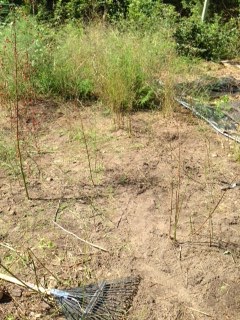
Here is the partially weeded asparagus bed.

A close-up of unweeded portion of the back of the bed.

Below is a picture of the asparagus bed after I spent two hours weeding it.  Later in the day, I hoed it lightly and fertilized it.  I’ll put down some straw to mulch the bed after the weeds in the upper layer of the soil have had time to sprout and I have hoed them down.  

Because I do not have time to pull out all the weeds by hand (if I did, I would not have allowed the garden to become so terribly full of weeds), I have used tarps, black plastic, and whatever else I can find to kill the weeds by covering them and preventing them from seeing the sun.  The dead grass on the right has been covered by a tarp; the grass on the left is enjoying summer.

This is my bed of collards.  I set the plants out as transplants after I repeatedly lightly hoed or tilled the soil to kill the weeds in the upper layer of the soil.  Killing weeds that have barely sprouted is easy.  Organic farmers use the stale seed bed method of planting seeds.  To have a “stale” bed, farmers repeatedly shallowly till the surface of the soil, which kills many seedlings while they are tiny and easy to kill.  Depending on the climate and the time of year, farmers also cover the beds to encourage seeds to sprout so they can be killed.

I have no trouble encouraging seeds to sprout, so I go over the bed with my Earthway Wheel Hoe
to kill the weeds that sprout.  This tool is basically a hoe attached to a wheel, and it’s so easy to use that a child, as long as he or she is tall enough to see over the handlebars, could operate it.  You must have relatively rock and weed-free soil, though.  It won’t cut through rocks or heavy weed roots.  It works perfectly to eliminate baby seedlings, though, as long as the soil is dry.  If the soil is moist, or rain is expected, weeds will re-sprout.

I try to run over the beds and pathways with this tool, or with any hoe or weeding implement, on the mornings of days when rain is not expected and the afternoon temperatures will rise into the 90s.  Sometimes I run a rake back over the beds to eliminate re-sprouting of the weeds.

After a pleasant morning’s work in the garden, I removed three or four wheelbarrow loads of weeds and their seeds.  I do not put them into the compost heap because the seeds would probably sprout eventually.  Instead, I put them in this heap in the edge of the woods where the tree canopy and root system deprives the seeds of the water, nutrients, and light they need to survive.

I have now mulched the asparagus bed with straw, which I hope will hold back the weeds until next year.  I should have mulched the bed last fall, but the obligations of children and other things kept me busy.  I also applied some organic fertilizer to the beds rather heavily in hopes of restoring the nutrients sucked off by all this crabgrass.