Posted on

We have baby chicks…

…but Mrs. Hen didn’t hatch them.  I found a broken egg on Sunday, and another one broken yesterday.  The eggs were well past 21 days incubation by then, and after scouring the Internet and asking anyone I could, I determined that the eggs were dead.  I don’t know why they died after living long enough to make a fully formed chick with feathers, but I have a few ideas.
1.  Chicken ineptitude.  Broodiness has been bred out of hens so that they have forgotten all their maternal instincts.   Although this hen sat faithfully on the eggs, perhaps she forgot to turn them enough or forgot to heat and cool them properly.
2.  SC’s heat wave.  See number 1.  For the first two weeks, SC’s early August weather was relatively cool.  If anyone is reading this who lives in a cool climate, you will think I am insane, but 85 or even 88 degrees F feels rather fall-like.  88 degrees, plus heat from the chicken body, shouldn’t exceed 100 degrees or so.  As I understand things, 99 degrees and 60% humidity is ideal for hatching chicken eggs.  Over the past week or so our air temperatures and humidity have gotten near this number.  My chicken house is in direct sun and the nesting boxes have a western exposure, so on hot afternoons I imagine the temperature under the eggs could easily exceed 99 degrees.  A broody who knows what she’s doing should be able to regulate the temperature, but maybe my chicken didn’t know how.
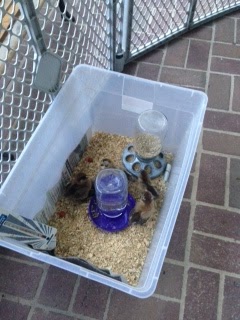
So yesterday my girls and I went to Sal’s Ol’ Timey Feed and Seed in Columbia, near my home, and picked out five Americana chicks.  We had all decided we wanted to have chicks.  I hoped the broody would accept them, but when I presented one to her under very close supervision, after removing her from the nest containing the dead eggs, she wasn’t interested.
Well, she was interested, and she even made some of the “churring” noises mother hens make to the babies, but then she went back to preening her feathers and trying to escape the new enclosure.

I was afraid to trust her with the babies.  And, I was afraid I couldn’t keep them safe in this rickety chicken tractor shack into which I would have had to put them if she wasn’t completely invested in caring for them.  So, the chicks are now living on the back screened porch which is, we pray, fortified against snake incursions.

Mrs. Hen and her companion have been banished to the chicken tractor with no access to nests. Without access to nesting material, they should forget about being broody in a week or so.  They spend their time trying to escape the chicken tractor; Mrs. Hen gave me quite a start this morning when I went out to check on her because she had vanished!  There were no signs of a struggle and, most importantly, no feathers (no chicken dies without feathers flying everywhere) and so I found her back in the chicken house sitting on a nest.  She had managed to push the wire aside and escape.  I put her back in the chicken tractor and fixed the hole with zip-ties.

Sal tells me that her Old English Game birds hatch out chicks regularly even in the heat.  Perhaps I will get some of them and try again one day.  We would love to see mama bird and her babies.  Maybe one of these new chicks will turn out to be a rooster and we will have our own fertile eggs.  For now, we will enjoy these babies.

Posted on 1 Comment

I Don’t Think I Will Eat My Chickens

My husband, Scott, and I have had many discussions about the
fate of my chickens once they stop laying eggs. 
We bought nine chickens, assuming that a couple of them would die in the
hands of an inexperienced chicken-keeper, but they all lived.  When I bought them at the feed store, they
were a couple of weeks old, so the weakest chicks in the batch had probably
already died. 

My fortified chicken coop has kept predators away, although
I am aware that one could gain entrance any night, especially if the power goes
out to the portable electronet fencing.  We
deliberately did not name the chickens, although I didn’t know how I’d feel
about eating the chickens after they quit laying, because I don’t need more
pets to live in my house and require veterinary care.  I have two very spoiled dachshunds. 

A Barred Plymouth Rock and a Buff Orpington chicken finishing off the pea crop

I told Scott that some of them would probably die of natural
causes anyway, and he said, not, I don’t think, intending it to be a
compliment, “The way you take care of those chickens they’ll live
forever.”   I make sure they have fresh food and water,
and clean ground to explore as often as possible.  I love seeing any creature doing what they
were meant to do, which in the case of chickens is scratching for bugs and
tidbits of food on the ground.  They
scratch first with one foot, then the other. 
Their eyes are on the sides of their heads so they must turn their heads
to the side to see the ground, and they search the ground for something to eat,
peck at it, and move on. 

They love loose, dry soil, and they dig out a hole, scratch
dirt into their feathers, wiggle and adjust their feathers to move the dirt
about, and bask in the sun while taking a dust bath.  They are unhappy when, after a rain, there is
no dry dirt in which to bathe.   Watching
contented chickens is like seeing children playing, deeply involved in some
imaginative game of their own invention that does not rely on electronics or
cartoon characters, or a dog snuggled in his bed asleep before a fire.   And just because the chickens are not pets,
it doesn’t mean I shouldn’t make them happy and give them opportunities to do
what they’d do if they weren’t in captivity. 
They love fresh green grass this time of year, and they rush towards the
new grass made available when I move their pen.

Chickens, when allowed to experience natural cycles of light
and dark, lay fewer eggs as the days shorten. 
Their bodies are very sensitive to daylight and to darkness; as the days
shorten when the Winter Solstice approaches later this month, they lay fewer
eggs, and as the days lengthen as the Summer Solstice approaches in June, they
lay more eggs.  During the summer, they
laid seven eggs almost every day; recently, I have been getting up to four eggs
daily.

The eggs we get are plenty for us even during the winter,
but some chicken-keepers keep a light on in the coop for part of the night to
make the chickens continue to lay eggs. 
In commercial chicken houses, where farmers keep chickens in cages so
small they cannot spread their wings, the lights are on all the time to trick
the chickens into laying constantly.   If you buy your eggs at the farmers market,
expect the farmer to have fewer eggs in the winter; get there early to purchase
yours.  Chickens also molt, during which
time they lose their feathers, regrow new ones, and cease laying entirely
before resuming laying a couple of months later.

Scott says he wants to put them in the stew pot when they
stop laying eggs in a few years.  I doubt
I will be able to eat a creature I have taken care of daily for so long, and I do
not know if he would be able to either. 
I know that my grandparents would laugh at that notion, but I didn’t
grow up eating chickens from the yard as they did, either, and my family will
not go hungry if we don’t eat the chickens. 

I won’t take them to the veterinarian if they become sick, although
I won’t allow them to suffer, but until they die of natural causes, I’ll give
them the best care possible.  Maybe we’ll
get some more chickens that we will designate as birds for meat from the
beginning, and we’ll harvest them when they are a few months old, before
they’ve been around very long. 


Posted on 2 Comments

What Are These Grubs Called?

Posted by Picasa

Last summer, I found these larvae, or grubs, or whatever they are called, living underneath and inside a black plastic bag I put broccoli plants in to kill the caterpillars that were feeding on them. Not having chickens at the time, I found them disgusting and imagined they would become another plague to attack my garden. I killed as many as I could, but I continued to find a few of them in the compost pile. I didn’t worry too much about it, because I hadn’t seen an influx of the creatures.

This summer, I have chickens, and I have found masses of the creatures happily wiggling in my compost. I test the chicken’s appetites on any critter that I don’t think is a beneficial insect, and they love these things.  I just don’t know what they are called. They prefer hot locations, like under a black plastic bag in the sun, and in the middle of a compost pile that’s becoming hot from the biological activity. I can’t see any harm they do, and the chickens love them, so I like their presence.

I wonder if they are Black soldier fly larvae, but my husband says he thinks they are too big to be a fly. The largest ones are about 1/2 inch long. He thinks they are a beetle. If you have any ideas, please let me know.