Posted on

Battling the clay and chicken-moving day

Our belongings are at the new house and we are still unpacking.  I knew moving with three children was going to be difficult, but I didn’t realize how long the unpacking would take.  We have too much stuff, even with all my decluttering efforts.

For the past couple of weeks, my chickens lived at my old house protected by electric netting.  My new home is close enough to the old one for me to check on the chickens.  Last week, a local towing company moved my chicken house.

You can get a nice view of some of the clay soil.  This soil is actually not as bad here as the soil up closer to the house.  I will need plenty of help from the chickens to fertilize and aerate this soil.  I have had the landscaper working on my yard till in granite dust leftover from the well drilling, lime, cottonseed meal, and several loads of horse manure.  I also saved chicken manure, in empty feed sacks, when I cleaned out the chicken house at my old home for months before our move and had it tilled in as well.   The garden soil will be okay without anymore extreme effort from me aside from planting cover crops.

I chose the longest day of the year, the summer solstice, to move the chickens.  I was late picking up my daughter from youth group because it was still just a bit too light outside that evening for the chickens to be in their nightly chicken-coma.  I caught these last two in a flurry of feathers and stuffed them into this metal bucket. They were content in there and, most importantly, could not fly out.  I transported them inside my SUV and let them sleep in my garage for the night.

At the front of the house, the soil is terrible.  Loads of bricks, lumber, and machinery sat in front of the house for months.  When rain falls, it puddles in front of the house in a mud slick on top of the hardpan.  I purchased a pickaxe to tackle this soil.  The man doing the landscaping found that his tractor’s tiller bounced off the clay, and they even had trouble getting an auger to go into the soil, but a pickaxe will go through.  I have given up my morning efforts on the elliptical trainer to spend time using the pickaxe.  It is definitely good for building muscles in my arms and back!

A pickaxe will go through the mud and the hardpan, and I have managed to break up the soil and to sprinkle in plenty of gypsum, a clay softener.  I have also added lime, copious amounts of horse and chicken manure, and some topsoil.  This area, on either side of the front walk, will be my flower garden.  I have downsized my gardening efforts from those at my old home,  and I hope to spend more concentrated effort on a few plants instead of having a mass of things that easily fall out of control.   I am building a sort of raised bed over this area, and I purchased some red worms and some night crawlers from the hardware store to inoculate the soil with worms.   The cover of soil and manure softens the clay and prevents it from turning into mud during the rain.

I’ll keep you updated on my gardening progress.   I miss working in the garden and I hope to get a fall vegetable garden planted.
 

Posted on

I was a guest on Deigo Footer’s Permaculture Voices Podcast!

You may listen here.I enjoy listening to podcasts about gardening, farming, and homeschooling.  I don’t want to have on the TV to watch the news, as was my habit before the children became old enough to notice, while I cook supper or do chores around the house because I want them to play, or to at least not be terrified by all the crazy things going on in the world.  I also enjoy listening to podcasts in the car when the children aren’t with me.  I educate myself through the efforts of people trying to do things in which I am interested.

So I found Deigo Footer’s Permaculture Voices Podcast, in which he talks about farming as well as about life in general.  I have raised two batches of meat birds for our own consumption, and I am interested in raising more.  He did a podcast on pastured poultry and I was interested in the amount of money a farmer could earn raising birds on pasture, and commented on the podcast.  I told him a bit about my experiences raising chickens, and he invited me to be a guest on the podcast on an episode about small-scale poultry raisers.  So here   it is.

Currently, I have 14 chickens and 5 chicks for eggs.  I am definitely not making anything off the eggs I do have; the eggs are the most expensive ones I have ever eaten!  But chickens are fun.

We live on five acres of land, where about 1 acre is relatively flat and cleared and the rest is in hilly woods, but we plan to start building a home on more land soon.  There is a former pasture of about three acres on this property, and the layout of the land is more conducive to moving chicken tractors.

I’m interested in doing something like this but it would be lighter and easier to move since my children and I would be doing the work.  I will be taking the birds to a local slaughterhouse for processing.  Here is a post about the first time I raised meat birds.

It would be a great part-time job for my children to earn some money and to understand the value of real work.  And it would be fun for me too.  (I know that sounds crazy, but as I told a friend, I really enjoy chickens.)

So here is my debut into podcasting.  I am first, so you can hear me without listening to the entire hour and 40 minutes unless you want to.  I enjoyed listening to everyone and learned a lot.  I say “Ummm” too much, I think….

Posted on

Baby chicks are enjoying some (well supervised) freedom in the unused cold frame

I have a covering to deter hawk attacks, and I visit them every ten minutes or so while they are outside (which is not long, because they will become chilled) to make sure snakes aren’t after them, but they understood dirt and its functions immediately,without the example of a mother hen, and began scratching and dust-bathing as soon as they could.  Here’s a video of them having fun.
Posted on

Waiting for baby chicks

This is a video of my chicken sitting on her eggs.My Buff Orpington chicken has persisted in her delusion that if she sits on eggs long enough, surely they will hatch.  Even though there is no rooster, and even though I removed the eggs every day, she still sat on the nest.  Earlier in the spring I removed a Buff Orpington (I don’t know if this is the same Buff Orpington chicken but I suspect that it is) and her co-delusional chicken to another chicken house without access to a nest for a couple of weeks to break the broodiness.  This process worked for a couple of months, but she has been broody for a month or more, I suppose.  I traveled a lot during July and was not certain which chicken was on the nest.

After I realized she was determined to raise some chicks, I remembered a friend’s offer of fertile eggs. We have had two roosters.  As my girls say, one of them  was nice and stupid, and the other one was mean and smart.  The nice one met his end defending the ladies against a bobcat, and the mean one died last summer at the end of a hatchet blade.  I had scars on my ankles from his spurs, my girls were scared to go into the chicken pen, and with a baby about to become a toddler I didn’t want to risk permanent damage to anyone.  We would like a nice and smart rooster to add to our flock.

My friend gave us a dozen fertile eggs.  In this video you can see and her co-broody.  Originally I planned to split the dozen eggs between the two hens because I believed the Barred Rock was also serious about broodiness.  After I put the eggs under her (watching her carefully and knowing that the ambient air temperature in SC in August is nearly hot enough to brood eggs without a chicken–just kidding, sort of) I realized within a day or less that she was not serious.  She got off the nest, forgot which nest she was supposed to sit on and got onto another nest, sat in the nest backwards, and is generally a mess.

After I saw my Buff Orpington in action, with her constant attention to the eggs and her faithful sitting except for a brief stretch and dust bath in the afternoon, I took the eggs from the Barred Rock and gave them all to the Buff.  One egg broke within the first couple of days.

Another egg broke earlier this week.  Inside the egg was an almost fully-formed chick, complete with feathers.  Although I was sad about the loss of the chick, I was glad to see that things were going okay with some of the eggs.

Earlier in the incubation period I held the eggs up to a flashlight beam and saw the eye spot and some blood vessels developing.  Now I see a dark blob in the eggs.  Eggs without a developing embryo are translucent.  Seeing the eye spots and blood vessels develop within the egg was nearly as exciting as seeing my own babies on ultrasound.  Okay maybe not quite that exciting, but seeing new life is miraculous!  Plus, I don’t have to be pregnant to see this life happen

Check out the video of the hen here on YouTube, and, as long as there is no disaster, I hope to share a video of chicks hatching within the next couple of days.  I put them under her on July 29; it takes 21 days for the chicks to hatch, so we expect babies within the next couple of days.  Maybe they will be here for the eclipse; we are in an area of totality and I also hope to share a video of my chickens going to roost in the middle of the day.


Posted on

My spring garden 2017

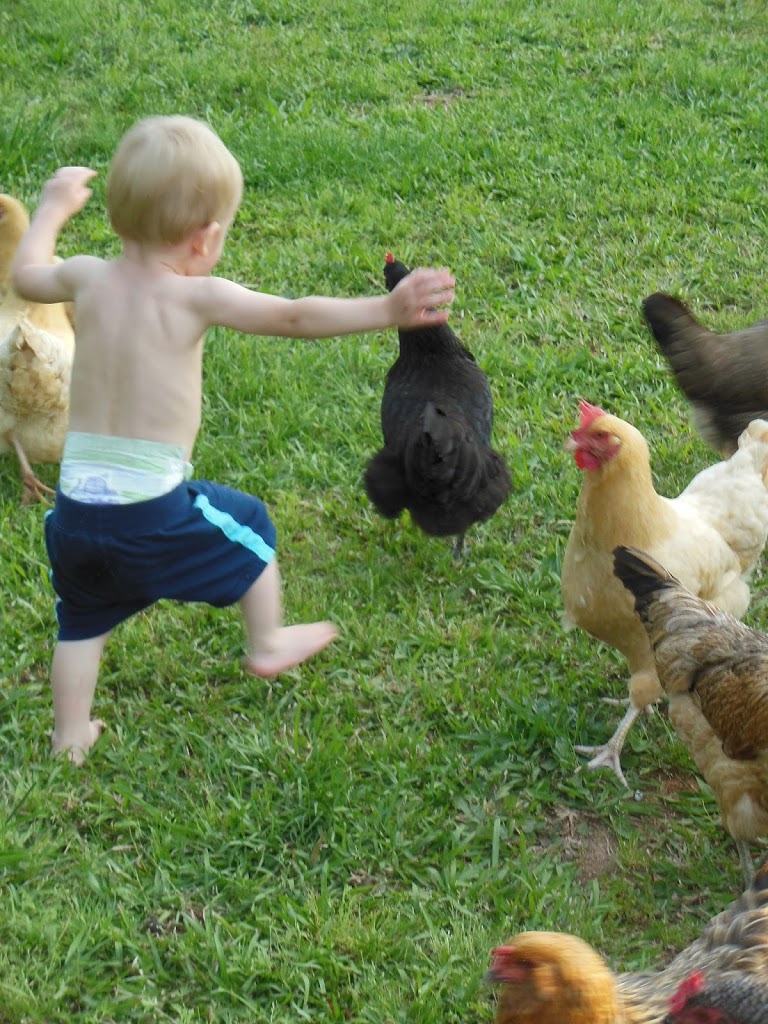
I haven’t posted anything in over two years thanks to the arrival of this sweet boy.  I could either spend my newly limited time and energy actually gardening, or writing about gardening, and I chose to enjoy the outdoors as much as possible.  After he learned to walk, spending time outside is his favorite activity.  He loves the chickens, and they, well, tolerate him I guess.

He is fascinated by their eyes and wants to poke at their eyes in the same way he enjoys poking at the eyes of people.

He does sample the dirt when he goes outside.  He will eventually decide that dirt is inedible, and will gain many immune-system-strengthening microbes in the process.  At least that’s what I tell myself, because it’s impossible to keep him from eating the dirt.  As long as we keep him out of the fire ants, the electric fence, and don’t let him eat chicken poo, I consider our outside time a success.

I’ve also had to have several serious conversations with my older girls, when I tell them to supervise him, about Why We Can’t Leave the Baby Outside Alone Even Though He Doesn’t Mind Being Left Alone.  I think they understand!

Here is an overview of the entire garden.  We haven’t had a frost here in about three weeks, and spring is fully committed to remaining.


Below is one of my asparagus patches, with crimson clover blooming red and blackberries blooming white along the fence.


Baby bean plants that have survived trampling by the toddler have four sets of leaves.

Several rows of garlic are happy in their mulch.  I was self-sufficient in garlic for many years, but last year my garlic rotted and I had to buy new seed garlic.  To the right, above the clover, are leeks.

I’m doing an experiment with cover crops this year.  This is the site of my tomato patch for the summer.  My plan is for the crimson clover and rye grass to die in the heat of summer and to provide a mulch for the tomatoes.  In past years I have spread hay as mulch, which is a time-consuming process, especially in the scale on which I grow tomatoes.  I let the chickens into the clover last week and they have helped trample it.

To the right are English peas, and to the left rear are Fava beans.  Cilantro flowers in front.

More beautiful asparagus below the peas.

Below is a closeup of the Fava beans.  I planted the seeds last fall.

These are thornless blackberry plants.  I was afraid the frost killed the buds, but they are blooming and even forming baby blackberries.  Perhaps the harvest will be as abundant as it was the summer I was pregnant with Luke and I canned 30 pints, or maybe even more, of blackberry jam.

Here is another experiment.  I planted Austrian winter peas in this bed.  Between the rows of peas, I cleared a furrow and sowed Crowder pea and lima bean seeds.  I plan for the beans and peas to grow and for the Austrian winter peas to die back as mulch in the heat of summer.