Posted on

The latest batch of pigs will be ready in May (ish)

When I didn’t have as much actual farming to do, I definitely posted more stories on my blog.

Posting on Facebook or Instagram is certainly faster for me, but I want to keep up with the website too.  And homeschool two children, drive the other one to private school, teach Sunday School, and generally be a mother and a wife.  Whew! But I do try.

Christmas vacation gave me some time to make seed orders, make planting plans for the spring and summer, so, I hope, I am not wondering why I can’t manage to have a steady supply of cut flowers and why I don’t have space open for the next crop.

Spring will bring flowers, farmers markets, and pork.  I expect to finish these pigs in May (ish) and you may place a deposit for preorder through my online store.  For details about how much meat to expect, final cost, and other information please visit this page.

The pigs came to the farm in early December, and they are enjoying life in the woods and on the pasture.  My oldest daughter has always been my livestock helper because, well, she is the oldest and the biggest.  At 14, she can now even help me lift heavy things.

One night as she was working frantically on a project for one of her classes, the pigs got out.  We have a driveway alarm so that we have some advance warning that someone is coming down the driveway, and my 5 year old loves to announce the identity of the new arrival.

We heard it go off about 5:20 PM, conveniently just before sunset on a day when temperatures hadn’t gotten out of the 30s and rain was expected.  My son heard the alarm, and yelled, “It’s probably Amazon!” as he scampered to the door to seek the identity of the new arrival.  He has taken pride in carrying in the delivery boxes and enjoys talking to the drivers during this past year of COVID.

Instead of bringing in a box, he yelled, “It’s the pigs!”

The notification that “The animals are out!” is information no farmer enjoys hearing.  My family had cattle, and I remember many calls from the neighbors over the years and the glum pronouncement that, “The cows are out,” from my father, which meant that everyone available was needed to quickly rectify the situation and to keep the cows off of the road.  Whatever else was going on in the house was abandoned until the cows were restored to their pasture.

These pigs didn’t know me well yet, and didn’t associate me with food, and I knew getting them back into the fence would be trickier than the recapture of the pig that strolled down the driveway on Easter morning, 2020, when we, dressed in Easter clothes as if we were actually going to church instead of watching it on TV, were preparing to sit down to watch the service and I got another announcement from the children of an unexpected visitor.  I was able to lead that pig back to her home with a scoop of food while still wearing a dress.

This time was much more difficult.

As to why the escaped, let me say it was entirely my fault and a comedy of errors in not securing the fencing and pen correctly.

I tried to lure them pigs back into the pen with food, but they scattered in all directions when I got too close, including through my flower field, towards the neighbor’s house, and in the direction of the road, although the road is a good distance from the pig pasture and they never got too close.  I am not an athlete and competitive sports has never interested me.  Six pigs running at full speed towards the road motivates me to run faster in ways a race with a human never has.

I asked my husband for help, and I determined that pig-catching was going to require at least three people: one to gently herd the pigs in the direction I wanted them to go  (me), one to hold up the fence (Ella, the 14 year old), and one to turn the electric fence off and on (Scott).  Clara wasn’t home and Luke, the 5 year old, was left to fend for himself in the house.  I told Ella that pig-catching was currently more important than schoolwork.

I remembered numerous farm situations in my childhood I hadn’t thought of in years: family members placed strategically around an area and my father giving instructions that were to be obeyed immediately without question.  Scott and Ella, for a time, questioned my commands (which weren’t always completely correct), but shouting questions across 100 feet of woods in the dark and the rain is highly inefficient.  When pigs are loose, someone needs to be in charge, and as I was the only one present with much animal-herding experience, I needed to be the one in charge.  I informed them that pig-herding called for “Obey first, ask questions later.”

Ella has learned over the years how to help me herd chickens back into the fence by walking slowly towards them, silently, raising her arms in the air, making sure to not crowd them and scare them to make them scatter.  These skills are much more effective with any sort of animal than shouting and running.

However, although now the pigs will follow me anywhere like a pack of dogs,  these pigs didn’t know me (associate me with food) yet, they were scared, and they weren’t sure exactly where they were supposed to go.  The were still in the training pen when they escaped, and their escape introduced them for the first time to the wonders of fresh grass, acorns, and plenty of room to run.  They had no motivation to go back into the pen.

After running across the field a few times (I quickly shed my heaviest coat) after the pigs, I gave up on getting them back into the pen and began trying to complete the repair of the electric fence around the whole pasture.  This involved an hour or so of me wearing my son’s camping headlamp while twisting and cutting wire with fingers numb to the cold.  I had at least done most of the repairs earlier in the week–removed trees and limbs from the fence, tightened most of the wire, and rearranged the fencing around the pen.  I intended to let the pigs out in the next couple of days anyway.

I ran through the woods, attempting to get ahead of the pigs to head them off so they would veer into the fence, while Ella stood by to raise and lower the wire and Scott turned the electricity to the fence off and on.  I stepped in stump holes and tripped over vines, but miraculously didn’t seriously injure myself.

Eventually, we got them sorted back in the fence, and I will make sure to not repeat that comedy of errors next time…although that was a great workout!

I expect these pigs to finish in May-ish.  I have them available for pre-order through my online store.  Non-refundable deposits are $50 for half a hog and $100 for a whole hog.  Please visit this page on my website for details about how much meat to expect and final cost.  If you have any further questions, please call me at 803.465.6666 or email me at onehubcapfarm@gmail.com.

Posted on 1 Comment

Summertime, and the pork is ready!

This has been, for everyone I suppose, the strangest summer I can remember.  It sort of seems like this summer began in March and shows no signs of ending.  Instead of having many hours child-free this summer to work while children were at camp, I have had them underfoot, and bored, all spring and summer.  I am thankful, of course, that we are all well and active.

Bacon, bacon, bacon!

I managed to get a butcher date with my processing plant on June 8, and consider myself fortunate that I got my meat back on July 13.  There is nothing like empty grocery store shelves to spur thoughts about where our food comes from, and so there has been an increased interest in local meat.  This is wonderful for everyone, but it does put a backlog in place at the one or two small processing plants accessible to small farmers in South Carolina.  So, I now have plenty of meat in stock, and you may email me with an order, visit me at the Blythewood Farmers Market on Wednesdays from 4-7, or order it from my online farm store. Meat is also available at Buddy’s Country Store on Hwy 321/Winnsboro Road in north Columbia.

Because my children will be going back to school in mid-to late-August in some form (I am praying that it will be what I want, which is private preschool, private high school, and homeschooled middle school–but I guess I don’t know that for sure because they could all have to be homeschooled), I will probably not be attending the Blythewood market much past mid-August.

This year has also been a learning experience with flowers.  I have been selling flowers at the Blythewood Farmers Market but they are also available for on-farm pickup through my online farm store.  I guess one of the few blessings from COVID was extra time at home not spent driving children from place to place that I could devote to soil preparation and planting.  As such, I have a large supply of flowers and I have enjoyed meeting and working with several local florists to help them provide locally grown fresh flowers to their customers.  My flower bouquets last 7-10 days with proper care.

I also have eggs from my chickens available at the farmers market and online.

If you pick up from the farm, I can arrange no-contact delivery for you on my shady porch.

Posted on

My spring garden 2017

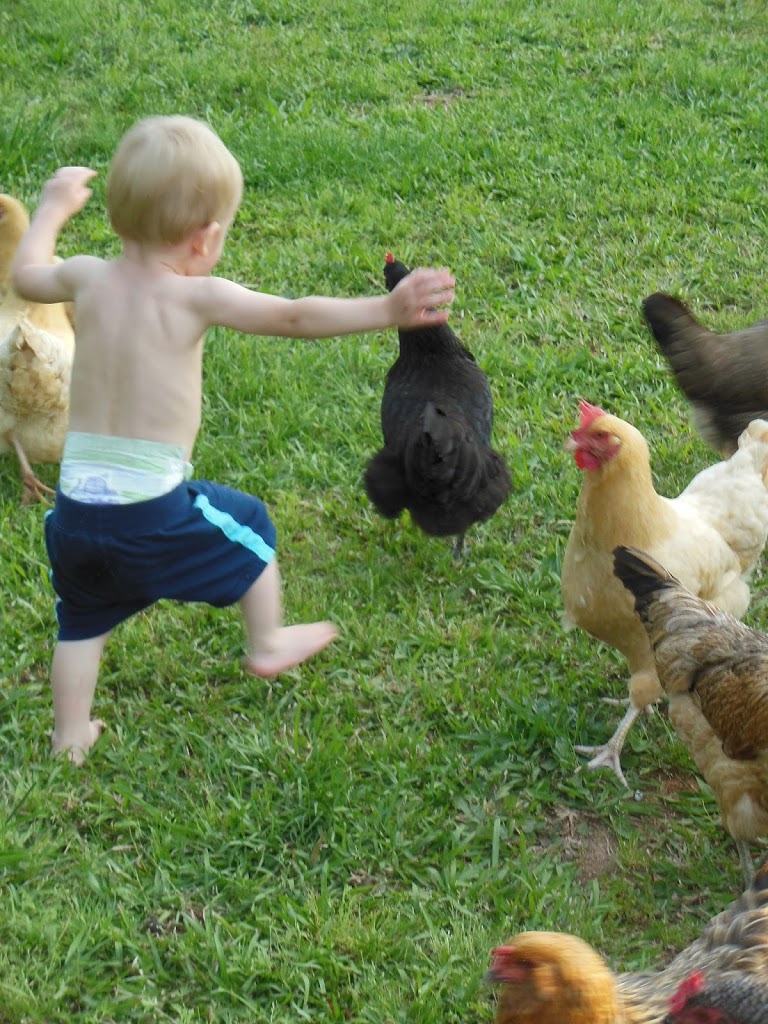
I haven’t posted anything in over two years thanks to the arrival of this sweet boy.  I could either spend my newly limited time and energy actually gardening, or writing about gardening, and I chose to enjoy the outdoors as much as possible.  After he learned to walk, spending time outside is his favorite activity.  He loves the chickens, and they, well, tolerate him I guess.

He is fascinated by their eyes and wants to poke at their eyes in the same way he enjoys poking at the eyes of people.

He does sample the dirt when he goes outside.  He will eventually decide that dirt is inedible, and will gain many immune-system-strengthening microbes in the process.  At least that’s what I tell myself, because it’s impossible to keep him from eating the dirt.  As long as we keep him out of the fire ants, the electric fence, and don’t let him eat chicken poo, I consider our outside time a success.

I’ve also had to have several serious conversations with my older girls, when I tell them to supervise him, about Why We Can’t Leave the Baby Outside Alone Even Though He Doesn’t Mind Being Left Alone.  I think they understand!

Here is an overview of the entire garden.  We haven’t had a frost here in about three weeks, and spring is fully committed to remaining.


Below is one of my asparagus patches, with crimson clover blooming red and blackberries blooming white along the fence.


Baby bean plants that have survived trampling by the toddler have four sets of leaves.

Several rows of garlic are happy in their mulch.  I was self-sufficient in garlic for many years, but last year my garlic rotted and I had to buy new seed garlic.  To the right, above the clover, are leeks.

I’m doing an experiment with cover crops this year.  This is the site of my tomato patch for the summer.  My plan is for the crimson clover and rye grass to die in the heat of summer and to provide a mulch for the tomatoes.  In past years I have spread hay as mulch, which is a time-consuming process, especially in the scale on which I grow tomatoes.  I let the chickens into the clover last week and they have helped trample it.

To the right are English peas, and to the left rear are Fava beans.  Cilantro flowers in front.

More beautiful asparagus below the peas.

Below is a closeup of the Fava beans.  I planted the seeds last fall.

These are thornless blackberry plants.  I was afraid the frost killed the buds, but they are blooming and even forming baby blackberries.  Perhaps the harvest will be as abundant as it was the summer I was pregnant with Luke and I canned 30 pints, or maybe even more, of blackberry jam.

Here is another experiment.  I planted Austrian winter peas in this bed.  Between the rows of peas, I cleared a furrow and sowed Crowder pea and lima bean seeds.  I plan for the beans and peas to grow and for the Austrian winter peas to die back as mulch in the heat of summer.


Posted on

A little New Year’s cheer and good luck

On this dreary January day, I thought you’d like to see these brave yellow flowers of the winter Jasmine that bloom throughout the coldest months of the year and remind us that spring will come.  Camellias and Mahonia are or are will soon bloom, adding more color and fragrance to the garden.  Ignore the dreary skies and visit the garden.

DSCN0074
DSCN0075
DSCN0077
Yesterday, my girls each found one four-leaf-clover, and combined with our black-eyed peas and collard greens, we are off  to a pleasant start to the new year.
DSCN0079
DSCN0080
Posted on

Gardening Developmental Milestones in Children

When I began gardening with my children, I did not realize that there would be a lengthy series of gardening “developmental milestones,” not described in my books about babies, that they would have to achieve before they could be more of a help than a hindrance in the garden. This weekend, when we planted beans, Ella, my 5 year old, achieved one of the most important milestones: placing the seeds in the row with approximately correct spacing without my constant supervision.

Before children can spend much time at all in the garden, they must be able to walk. My children both walked very late, and even after they began walking on hard surfaces, they needed a lot of practice before they could walk on uneven surfaces without falling, so throughout most of the first two years of their lives, I couldn’t do much in the garden when they were outside. Once my children walked well, they began moving through the other developmental milestones: not eating dirt at every opportunity, only eating plants or berries an adult approves, not pouring out the entire seed packet in one spot, walking around plants instead of on them, and walking only on mulched paths in the garden.

At about age four, Ella began achieving more complicated milestones such as remembering to use two hands to pick beans and peas so she didn’t tear up the plant in the picking process, and knowing what is ripe and what is not (this generally requires some taste tests to be sure I am right about what is ripe and what is not, especially where fruit is concerned). She also started taking plants out of their nursery containers and tearing apart the roots enough, but not too much, before helping me plant them. She learned how to place a single seed where I directed her; later on, I gave her an appropriate number of seeds and told her to spread them out enough to make them last the entire row.

Saturday morning, when Ella helped me plant beans, I showed her how far apart to space the beans, gave her a container of seed, and went off to other tasks. When I returned, I discovered that she’d correctly planted the seeds, and I dug another row and told her to plant it. With her unexpected help, I was able to plant several more rows of beans than I thought I would have time to sow. Later, I gave her the clippers and asked her to pick the eggplant; she was able to decide which ones were the largest ones and which ones were too small, and to pick accordingly.

Meanwhile, her two-year-old sister, Clara, was pouring out her bean seed in a pile in the row, and wanting more to plant. It will be awhile before she passes through the developmental milestones and is able to be more of a help than a hindrance, but at least she doesn’t eat too much dirt anymore. Anyone with small children knows they love to “help,” and most of the time that help results in an easy task taking twice as long as it should. However, when they are finally able to be of real help, the training time is worth it, as is the pride they display in telling others about their accomplishments.