Posted on

Rain, Rain, Go Away, Little Mary Ann Wants to Play (in the garden)

All I can really talk about this last month is RAIN. Ordinarily I am happy to see the rain. I know that in the winter in my climate, South Carolina Zone 8a, rain falls. The winter rains fill my well and furnish the lakes and rivers with sufficient water to last through July. Normally, my thoughts on rain are neutral, like those of Robert Louis Stevenson:

Rain by Robert Louis Stevenson

The rain is raining all around,
It falls on field and tree,
It rains on the umbrellas here,
And on the ships at sea.

This sort of rain is probably falling gently on an English garden. It doesn’t wash away homes, plans, or gardens. I like this sort of rain. I appreciate its ability to keep me indoors on a day I would rather be outside in the garden but I need to stay indoors. Maybe I get rainy days because, as an unknown author said,

“God made rainy days so gardeners could get the housework done.”

(At least I could try to get it done but with three children and lots of mud created by said rain, it’s unlikely that it would actually ever be DONE.)

This winter, we have had Forrest Gump rain:

“One day it started raining, and it didn’t quit for four months. We been through every kind of rain there is. Little bitty stingin’ rain, and big ol’ fat rain, rain that flew in sideways, and sometimes rain even seemed to come straight up from underneath. ”

Forrest must have been in Blythewood, South Carolina instead of Vietnam.

I do take a certain amount of joy in hearing the rain pound on my metal roof. I do not enjoy seeing what scanty topsoil my garden may possess wash down the hill towards the ocean.

I can’t let all this good soil wash away

Erosion

We have been working as hard as possible to stop the erosion around our house. As mother did when I walked with her through the woods as a child, I stop my children when we wander among the trees and look for fox dens to lay logs and sticks horizontally across areas that might become gullies if we don’t stop the erosion.

Over Christmas, my children and I went to the enormous gully at the bottom of my parents’ pasture to gather greenery to make wreaths that began to form, I suppose, when my great-grandfather cut all the timber off of the gently sloping hill. He cut the timber as compensation for being able to use the land, and he removed it all, with the help of a few relatives, by using an ax to cut the trees and mules to move the timber. Imagine the determination it took for him to do this sort of work with no chainsaw, backhoe, bulldozer, truck, or any other sort of machinery.

There are no deep gullies on my property, but there are the beginnings of gullies. I live in the relative flat-lands of the middle of South Carolina, and so gravity has been on the side of the people who cleared the trees from this land the first time. As I tell my daughter when she wonders when she will ever need to know formulas about gravity and mass and slope and such, water flowing down a hill moves faster and is more destructive than water flowing along a flat surface, and the steeper the slope of the hill, the faster it moves.

Gardening in spite of the rain

To plant my crops on time, I have been employing several strategies from no-till methods of cultivation. I acquired many of my ideas from the book, “The Market Gardener,” by J.M. Fortier. He has a website that details much of the information in his book.

I gleaned many of my weed-control strategies from him and I also wrote my own eBook, called How to Have a Weed-Free Garden: Using easy organic methods. Fortier, because he lives in Canada, is mostly concerned with being able to plant on time because of snow and frozen ground. He uses tarps both to kill weeds and to keep the soil dry and to accelerate thawing of the soil in the spring.

I use his methods to keep my soil from washing away and to enable me to plant even when the entire world, it seems, is covered with mud. This morning I took the video below to show you my garden even in the midst of this week’s monsoon. The ditches between the raised beds prevent the soil in the planting beds from washing away.

The weather forecast promises me three days of sunshine after today, so I intend to don boots, wade through the mud, and plant my seedlings in the dry soil. You all would like flower bouquets in time for Easter, maybe, or at least Mother’s Day, right? I surely would.

Here is what I was doing in another March when the weather was behaving: planting potatoes! It is time to get them into the ground if you can save them from the rain. Make sure your soil is well-drained because they will rot if left in muddy soil.
Posted on

The Broadfork: My new favorite tool

When we purchased the land on which the house and garden now sit nearly two years ago, it was covered with scraggly pine trees.  I found a penny dated 1962 on the ground, and based on what the neighbors tell me, the land was last in a functional pasture sometime in the 1960s.  In the intervening decades, pine trees and sweet gums took over the pasture and returned it to forest.

Clearing all those trees required a nice man with a bulldozer.  He knocked over the trees, pushed them into a pile, and burned them for us.  I am sure that burning giant piles of trees was not the most environmentally friendly method of disposal, but we had 2 acres of trees and roots to get rid of.  We briefly considered chipping them into mulch, but the cost was prohibitive and we would still have had more mulch than we could ever use.  Eventually it would have rotted, but in the interim it would have provided the perfect habitat for snakes and fire ants.

The nice man with the bulldozer brought in some topsoil to fill in a hole created when we had to borrow some soil to move up nearer the house to fill in a low spot.  After he brought in the soil,  he spread it where I asked, and then rode back and forth over the spot to make sure it was smooth, packing it down into something like concrete.  I describe the process in more detail in Beginnings.

The landscaper did till the soil in my garden spot for me, but even after the tillage a hard layer of soil remained.  Although I dug the garden at my old house with a mattock and a spading fork, I needed something that would complete the job more quickly and with less effort.

I purchased a broadfork last week, from Johnny’s Seeds.  (I am not receiving any compensation for this post; I thought linking to their website might explain it better than I can).

img_3752
Broadfork sitting on top of the soil.

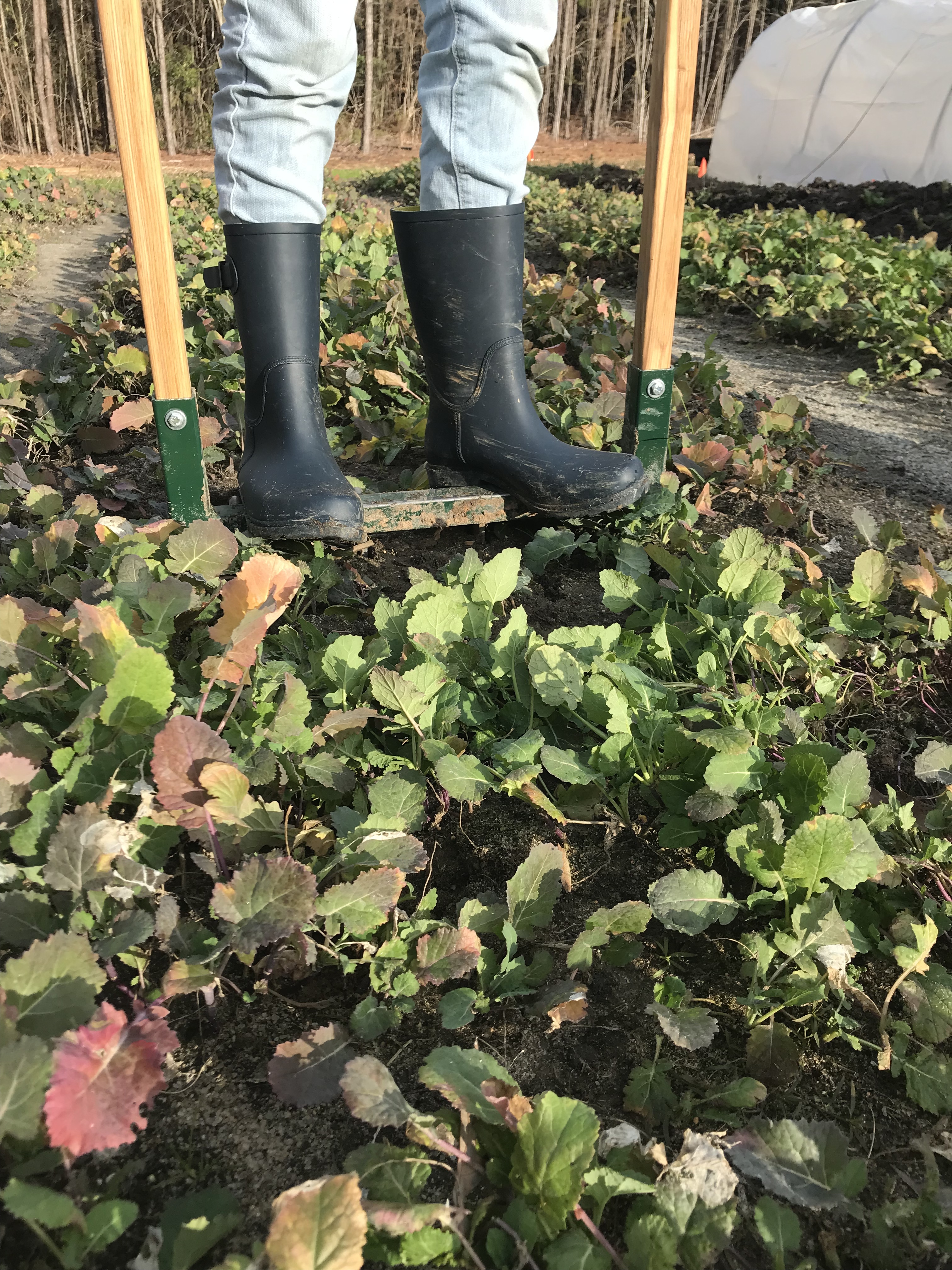
The blades are about 10 inches long.  My 12-year-old thought the work looked fun, and I let her help.

img_3753

She pressed the broadfork into the soil and then stood on it.  It entered the soil, but to put it into the full depth I had to stand on the broadfork and rock it back and forth.  Using the broadfork sort of reminds me of standing on a pogo-stick, although I don’t jump up and down but instead wiggle and rock it around.

img_3759

The blades of the broadfork break through the hardpan, and then I pull it back towards the ground.  I want to turn in this cover crop and do some more tillage of this soil, so I laid it back onto the ground.

img_3762

This loosens the soil about eight inches deep, and it is now easy to rake and to smooth the soil.  When I felt particularly energetic, I raked aside this now-fluffy soil and repeated the process of breaking up the soil and turning it over again.img_3764

To till the soil this deeply with any other method, I would have had to use a pickaxe.  My 12-year-old definitely could not have helped with that project.  I could have hired someone to till the soil, but that would have destroyed the beds I have created.  The tractor tires would have compacted much of the soil again.  I would also have had to wait until the soil was dry enough for a tractor or a tiller, and I don’t know when that might happen.

img_3765
At the top of the picture is soil that has been turned over and raked with the broadfork; at the bottom is an undisturbed bed.

I can take out the broadfork at almost any time to work the soil.  After I do the initial tillage of the soil, I won’t turn it over again.  Instead I will go through the beds, drive the broadfork into the soil, rock it back and forth a few inches, and move onto the next spot.

I used it in the lawn and the flowerbeds; those areas have also been victim to a bulldozer as well as the receptacle for piles of bricks and construction materials.  Water stands during rains in my flowerbeds, and I hope that the aeration with the broadfork will help.  I did not turn over the soil in my established beds or in my lawn, of course, I just rocked the blades back and forth to loosen and to aerate it.

For more on my work to transform my yard from a mud slick into a garden, visit Oh, this soil.  The best thing about using the broadfork is that there is nothing to break, no noise, and I can forgo any other workout on the day I use it.  And, if only she weighed a bit more, my 12-year-old could do the work.  It is satisfying and not overly difficult work.