Posted on

Beginnings

Longtime readers of my former blog, Mary Ann’s Country Garden, will notice that I have changed the name of my blog and redirect visitors to this one.  I imported all of my old blog posts to this website because we are moving to a new home and garden we are building about fifteen minutes away from my old place.  I thought about leaving my old blog up and starting a new one, but I decided to integrate the two onto this blog.

Deciding to move

Although I had lived and gardened on 5 acres in the country outside of Columbia, South Carolina, for nearly 14 years, I always wanted to be a bit closer to town, while still living in a rural setting with land.

My husband and I (mostly me) considered moving a couple of times, but we never found a home or land that fit us.  After our last discussion about moving, when we looked at a few properties but felt right about none, I had prayed about whether or not we should move.

I felt God saying, “Not now.”  Now was not the time, but the time might come at some time in the future.  I was nearly 40 years old, but I was expecting my baby Luke two months later.

Looking for land

In January of 2017, after our house had become a bit cramped with the addition of another child,  I drove down a country road close to town looking for land for sale, and I found a battered “For Sale” sign in front of an abandoned-looking field.

We toured the property soon after, and I loved it immediately.  It was covered with mature hardwoods, aside from a scruffy, overgrown former pasture of a couple of acres, and several acres in the middle that the previous owners had clear-cut 20 years ago and the always opportunistic pine trees had reclaimed.

House site before bulldozers

The land reminds me of the place I grew up in Spartanburg County, SC.  My family has farmed that land for over 150 years through sharecropping and renting land, and my family has lived in the same area of southern Spartanburg County since the colonial days.  In the 1920s, My grandparents were finally able to buy the land from the family from whom they rented the land.

On my family’s land,  the flatter land was planted in cotton and suffered the ravages of erosion.  Mature oaks, maples, and poplars shed their leaves on the native soil in woods with hills too steep to be planted with cotton.  The huge trees shade out the underbrush and keep the forest from feeling like a jungle covered with shrubby undergrowth and vines.

On my family’s land is an ancient beech tree onto which, for generations, family members have carved their initials.  Beech trees inhabit this new property too, and it immediately felt like home.  What was “Not now,” several years ago had become “Now.”

Getting ready for the house

We cleared about five acres total including the pasture out front, the driveway, the house site, and room for the garden, chicken house, septic field, and room for my children to play.

Field cleared in front of the house

Most of what we cut were fairly young trees that had regrown in the space that was clear-cut about 20 years ago.  Farther into the woods are the hundred-year-old hardwoods that we did not touch.  We didn’t want to put the house right on the road, in the cleared pasture area, and fortunately for us, and for the trees, the next most logical building spot was in this formerly clear-cut area.

Behind the house: future garden and chicken yard

Plans

What will we do with all this land?  For many years, I have wanted to try raising and selling pastured meat.  If I don’t sell it, I will raise it for myself and my family.  The weed-choked pasture out front is the perfect place for hogs to clear, and they will also like rooting among the mature oaks for acorns on which they can fatten.  When we turn the pasture into something besides a field of blackberries and scrubby regrowth of trees, chicken tractors will float across the pasture and the level ground will make moving them easy.

My first project will be getting something growing on all that clay, probably brown-top millet, and running some chickens over it for fertilization.  Maybe we will get a good perimeter fence up and put hogs on the front pasture or down in the woods.

In the meantime, I’ll put my laying hens on the garden site to work on that soil.  I’ll be hauling composted chicken manure from the other house over there if it ever stops raining, thank you Tropical Storm Alberto.
 

Posted on

My new adventures

I haven’t written a post here in a long time.  I have been doing a few other things instead of writing about gardening, although I still love my garden!   We are moving to a new property where we are building a house.  You can visit my Pinterest board if you would like to see some pictures of the house and property.  I will be rebuilding a new garden there, and we might hope to raise some pigs as well as more chickens. 

Since I can’t garden on the new property, and I as we are moving in the next couple of months I can’t put in a summer garden here, I have begun sewing.  I started making rompers/Jon Jons for my toddler.  I enjoyed it, and so I opened an Etsy shop.  I make rompers, tea towels, burp cloths, and wreaths.  Click here to visit my shop. 

Perhaps I will be back later to write about my new garden, and I will make sure to show the new owners of my home this blog.  I do hope they love gardening too, as all my work will make things easy for them.  But if they don’t, that is okay too. 

Posted on

Start Your Own Transplants with Grow Lights

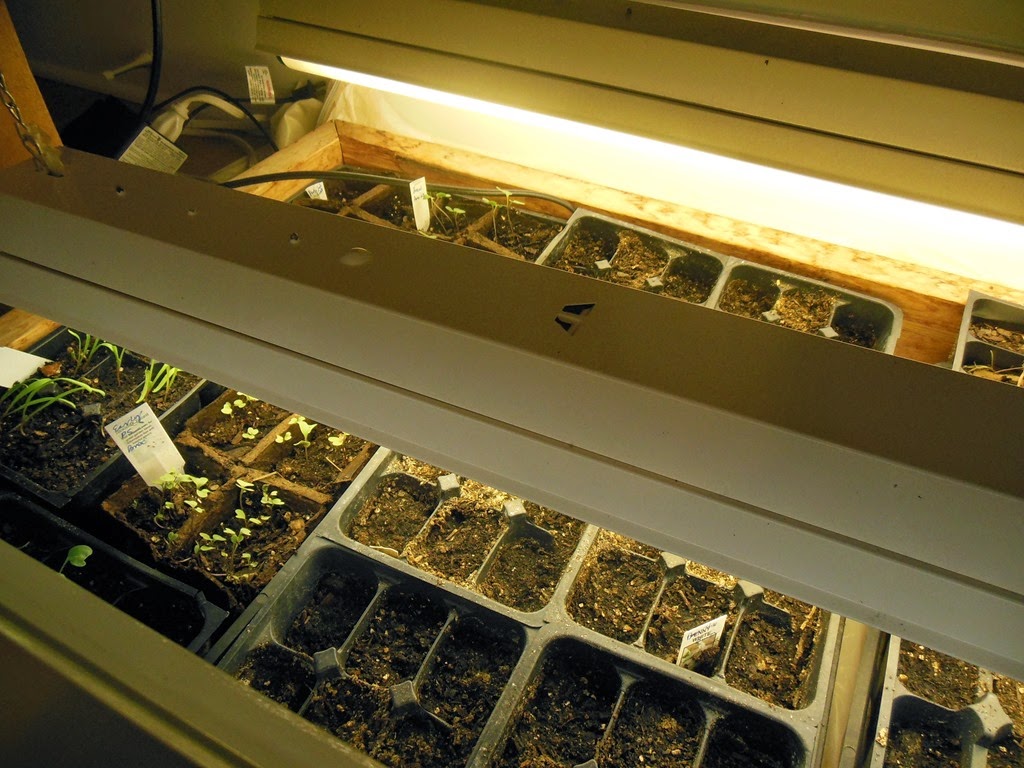
 Even though it’s cold outside, I’ve been gardening indoors for a couple of weeks.  My husband I made these lights many winters ago, and I use them every winter to grow seedlings.  I don’t have a greenhouse, but these lights allow me to start my seedlings inside the house.

DSCN0667
Seedlings grow inside my house
DSCN0668
I sowed seed in these pots last Thursday.
To make grow lights, you will need lumber (figure out how much you will need based on your measurements), nails, and hooks from which you will hang the lights.  We got three fluorescent shop lights to provide adequate illumination across the width of the seedling flats.  I have never used the lights designed for plants, but my seedlings are growing too tall and leggy, so I have ordered some lights that have all the correct light waves needed by plants.
DSCN0669
Kale seedlings strain to reach the lights
To replicate my frame, make a frame wide enough to hold a nursery flat, or with an interior width of about 22 ½ inches.  Make the frame long enough to accommodate the lights and four nursery flats; mine is about 4 feet, 3 inches long.  Add two posts on each end and a beam down the middle of the frame, and make two arms across the beam to hold the lights.  The arms are about 22 inches off the floor.  Screw the hooks in at the appropriate place on the arms, and hang the lights from the chains.  I use an old shower curtain under the grow lights to protect the floor from water, and I place the lights on a timer for 12 hours of light a day.


growlights 001
When I first plant the seeds, I hang the lights as low as possible; as the seedlings grow, I raise them so the lights are just above the foliage.  Fluorescent lights give off very little heat so they will not scorch the foliage as long as they are not actually touching it.    I use a heat mat, which is a waterproof pad that provides the seedlings with bottom heat to help them germinate quickly, under the seed trays if the weather outside is very cold.  It helped my heat loving plants grow well, but it made my cold-tolerant plants, like broccoli, grow too quickly.
Grow lights make the process of starting seeds easier because I don’t have to move my seedlings around the house as the sun moves to make sure they have adequate exposure to light, and because I don’t have to take them outside for sun until the weather is consistently warm.  Seedlings, like all baby creatures, appreciate consistent warmth, moisture, and food, and keeping the seedlings under grow lights helps them thrive.  If you don’t want to build your own grow light, look online for premade versions.
If you want premade grow lights, light bulbs, or other seed starting supplies, consider purchasing these products:


Posted on

February in the Garden

DSCN0661
We’ve had nice weather here in SC for the past couple of weeks, and  I’ve been busy turning in cover crops of clover, rye, and turnip greens to enrich the soil.

DSCN0662

I’ve sowed seeds of spring vegetables under floating row covers.  I place the row cover over wire hoops I cut from wire used for chain-link fencing protect seedlings.  The cover protects the baby seedlings from wind, driving rain, and raises the air temperature a few degrees.  

DSCN0663
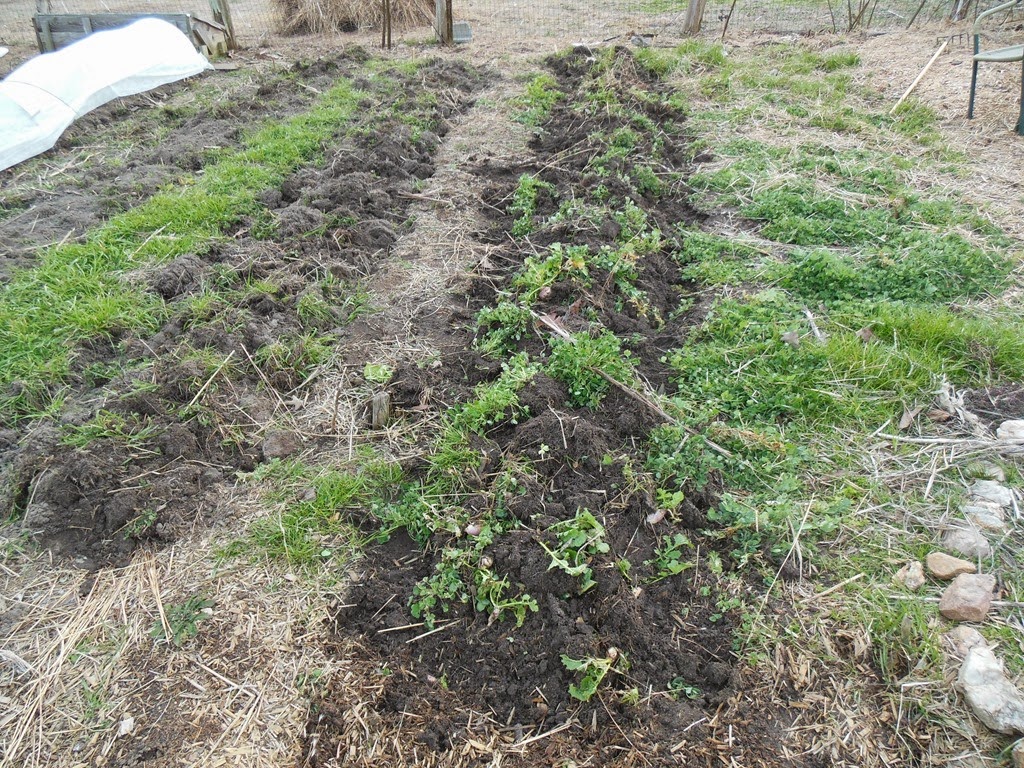
Last weekend, the temperature was nearly 70 degrees and the sun shone all weekend.  I opened the windows in the house to give us fresh air, and I planted 14 pounds of potatoes.  To the left are potatoes I planted a week ago.  To the right, spinach and lettuce enjoy their blanket.


DSCN0666

This will be my tomato patch.  Instead of turning in the entire row of cover crop, I dug individual holes for the tomatoes and turned in the crop in that area only.  By the time I’m ready to plant the tomatoes, the cover crop under the soil will have decomposed and enriched the soil.  This location got a lot of traffic from my chickens over the winter, so I hope it will have plenty of nutrients for healthy tomatoes.  The heat should kill the Austrian Winter Peas and rye and will make a mulch.

DSCN0665
I love working in the garden in the winter.  Instead of being disgustingly sweaty in equally gross clothes, as I am in the summer, I can wear decent clothes and look like those photos of gardeners I see in gardening magazines that must live in cooler climates.  You know, there they are trellising the tomatoes and picking beans, and they appear ready for an LL Bean cover shot.  Not that I ever look ready for a magazine shoot, (ha!) but when I trellis tomatoes and pick beans I’m covered with dirt, insect bites, and sweat.  At least in the winter I could, theoretically, go directly to the grocery store, without a shower, from the garden.
Posted on 2 Comments

Eating My Chickens

As I helped unload my chickens at the slaughterhouse on the early December morning, I experienced a mixture of emotions.  I felt relief that my two hour trip with 17 chickens in my SUV was over, and I felt satisfied that I had finished the job I
began 6 weeks ago.  My husband and I arose during the night, when the chickens were still in their chicken-coma of sleep, and put them, inside pet carriers, in the plastic-lined back of my SUV.  I rolled down the windows and blasted the heat the entire trip, and it was not as bad as I had imagined.  Although we have a truck, I did not want to expose the chickens to a 2-hour ride in the open air in December.  After a thorough airing, vacuuming, and cleaning, my SUV’s smell returned to normal.
IMG_4010
Calm birds leaving for the slaughterhouse
 I felt pride that my birds had redder combs, brighter eyes, and more darkly pigmented skin on their feet than some other birds awaiting slaughter that had not, perhaps, seen as much of  the sunshine and the green grass as mine had enjoyed.  I also felt sad that their lives were ending so that I could eat.  I said a prayer of thanksgiving to God, and I thanked the birds for their lives.
The chickens had no idea what was about to happen.  Poultry do not worry about tomorrow.  When they arrived at the slaughterhouse, a little after sunrise, they were barely awake. They sat calmly in the crate, and then the workers took them inside the facility, put them in a carbon-dioxide chamber, where they went to sleep and
died.  No drama of a chicken running about with her head cut off for these birds.
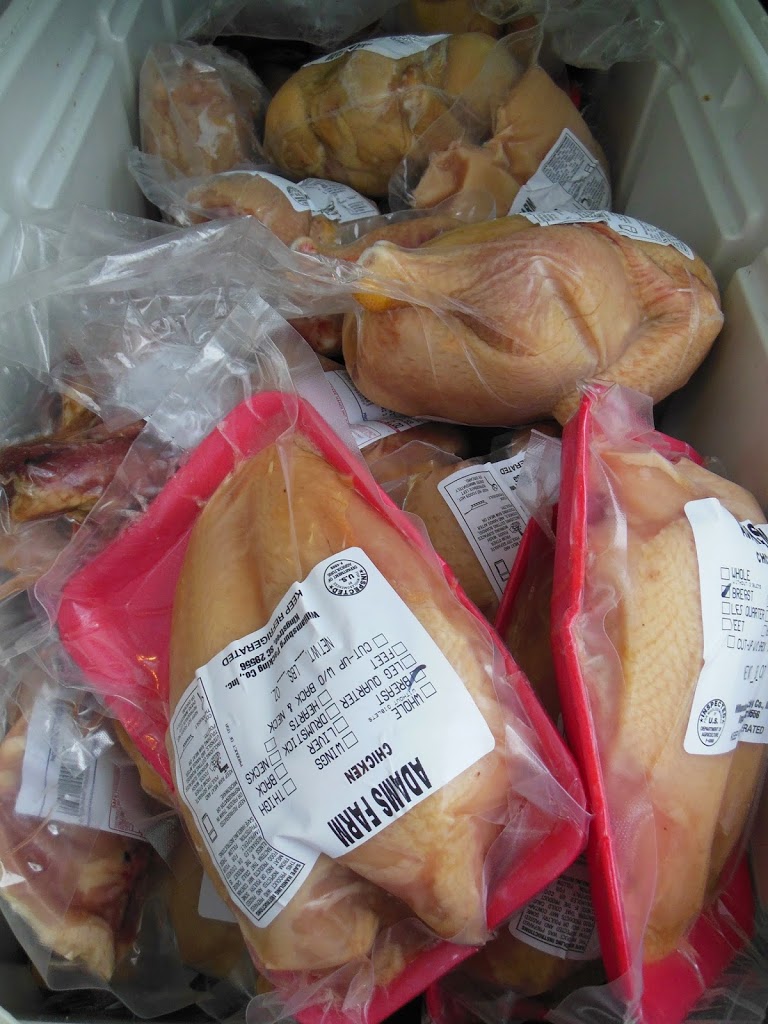
A few days later, I returned to pick up my meat.  The box of chicks, weighing a couple of pounds, which I opened on October 20, had turned into nearly 75 pounds of meat by December 3.

This is what I picked up a few days later
Was this a cost-effective undertaking?  As long as I do not pay myself an hourly wage for my labors, it was.  Considering the cost of the chicks, feed, and processing, I paid about $3.50 a pound for free-range meat (and mine got more free-range and green grass than many chickens labeled free-range).  The $3.50 a pound
applies to all cuts of meat—so I got boneless skinless chicken breast for the
same price I got chicken necks.   I did not include the cost of fuel to
transport the chicks and meat or the cost of electricity for the heat lamps in
this calculation.They were not organic because organic chicken feed is not available for sale in my area to anyone(unless you want to pay to have it shipped from another state, which is cost-prohibitive), but they did have green grass and some insects and worms, which is more than many chickens raised certified organic from the grocery store receive.  I did not medicate or vaccinate them.  Compared to other free-range meat I
have purchased—free-range boneless skinless chicken breast can be nearly $10 a
pound–this was a bargain. To reduce the costs, I could have slaughtered them myself, but I was not and am not able or ready to do that.  Maybe someday.  I could have also purchased them in August when the heating bills would have been much lower.  I will definitely do this project in a warmer month next time.

We have had several chicken dinners.  The meat is delicious, fresh and tender.  The fat is a deep yellow thanks to the birds’ exposure to sun and green grass, instead of the pale beige fat found on store-bought birds.  I know that these birds had a good life.

DSCN0559
Our first meal of chicken wings

My children are young enough that this seems like something normal.  Eating animals you either raise yourself, or kill yourself,  is normal, and it’s what people have done for the entirety of human history, except for the past 50 years or so when it became normal to have your meat raised by someone else so you didn’t have to participate in the messiness of life and of death.

From the day the chicks came home, we all knew we were going to eat these birds, and although my children had moments of sadness about it, as we all did, I made it very clear to them (and reiterated it to myself) that anytime we eat chicken meat, the food started out as fluffy chicks.  I made sure I could not change my mind about the fate of these chicks by ordering all male chicks.  I couldn’t have 17 roosters.  My 5-year-old horrified a new babysitter by saying, with delight, “We have baby chicks in our garage and we’re going to EAT them!”  That gave me an opportunity to talk about the origins of our food to another person who eats meat but doesn’t give much thought to its origins.

If you’d like to raise chicks yourself,  Murray McMurray Hatchery will begin shipping chicks in late January or early February.  Be sure to read and to follow the directions carefully about raising the chicks, especially if you purchase a hybrid breed.  Local feed stores will carry chicks beginning in early February.