Posted on

Weeds!

As I look back over my years of writing this blog, and when I think of September or October in the garden, I see that I faced the same problem every year:  out of control weeds.  Somehow the oppressive heat of August makes me reluctant to give the garden enough attention and the weeds get ahead of me.  For two Augusts,  I was in the sickly, exhausted stages of early pregnancy, and in two more Augusts I had infants that needed more care than the garden.  And in one more August I was 30 weeks pregnant, at age 40, and I could barely take care of my other two children and get dinner on the table, much less weed the garden.  Life happens to us sometimes.   All those years of weeds going to seed placed hundreds of thousands of seeds in the garden soil.

Oh, those weeds!

This past August, I moved away from my garden, and I was taking care of a new garden that I hope to keep free of weeds through some better strategies (more on that later).  The weeds reproduced with abandon in my old garden.

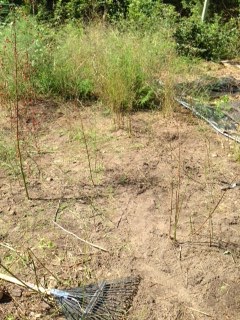
Our house is on the market still, and I went to the garden to try to gain some control over the weeds to help out the future homeowners.  They might bulldoze the entire garden, established asparagus plants and blackberries included, but I don’t want to think about that.  I will try to control the weeds and imagine them having a lovely garden in this space, thanking the person who produced this beautiful nutrient-rich soil for them, even if it is weedy.  In any case, the garden looks pretty frightening in its current state and cannot be a selling point.

If your garden looks like the picture above, it’s time for some weed triage.  If I had the time, I would go around and hand-pull as many of the crabgrass plants that are going to seed as I could.  I would place them in a garbage bag and dispose of them either in the trash or in a place so deeply shaded in the woods that the seeds couldn’t germinate.  I would use the bag, or a solid container, to keep those seeds from spreading any more.

After I pulled some weeds, I laid down tarps over the weeds.  While we still own the home, I will move the tarps around to other sections of the garden to kill the weeds.  Most weeds die within a week.  Hurricane Michael is on his way to us, so I made sure to weight down the edges of the tarps with extra stones.

If you have a similar disaster of weeds in your garden, I will offer some suggestions to help eliminate the weeds for next year.

  • Move the tarps weekly, or when the weeds underneath have turned a sickly yellow-brown.  If some green remains, they aren’t dead.
  • Rake aside and remove the dead weeds to a place outside the garden.
  • Encourage the next generation of weed seeds to germinate by lightly disturbing the surface of the soil with a landscape rake.
  • If rain is not expected, water the soil.
  • Wait for the weeds to germinate, and place tarps over those areas again to kill the weeds, flame weed, or lightly hoe the space.
  • Repeat this process again and again, and you will have reduced the weed seed bank significantly.
  • Do not till or disturb the soil below the surface.  If you need to lay off rows or to construct beds, do this and then water the soil, wait for germination, and lay the tarps on the area again to kill the weeds.
  • I use 6mil or thicker black plastic, or regular tarps that are UV stabilized.  If I put the tarps and plastic away when I am not using them, they will last many years.  Do not use think plastic or landscape fabric; it decomposes within a few months.
 

Posted on

Weeds, weeds, weeds!

The weeds have gotten ahead of me this summer.  We have been busy with traveling and taking my children to camps, and keeping up with the toddler precludes vanishing to the garden for hours.  He does enjoy playing in the garden and my older children and husband do watch him for me occasionally.

The main problem (and blessing) I’ve had this summer has been the rain.  I think I am in something of a microclimate because the weather data I can find from the airport that’s about 45 minutes away from here indicates that our rainfall is slightly below normal.  All I can say is that our lawn is a beautiful, soft, swath of green that hasn’t been watered at all this year, and the crabgrass is two feet tall in places inside the garden.  The tomatoes and okra did poorly, and mildew has been a problem on the beans.

Here is the partially weeded asparagus bed.

A close-up of unweeded portion of the back of the bed.

Below is a picture of the asparagus bed after I spent two hours weeding it.  Later in the day, I hoed it lightly and fertilized it.  I’ll put down some straw to mulch the bed after the weeds in the upper layer of the soil have had time to sprout and I have hoed them down.  

Because I do not have time to pull out all the weeds by hand (if I did, I would not have allowed the garden to become so terribly full of weeds), I have used tarps, black plastic, and whatever else I can find to kill the weeds by covering them and preventing them from seeing the sun.  The dead grass on the right has been covered by a tarp; the grass on the left is enjoying summer.

This is my bed of collards.  I set the plants out as transplants after I repeatedly lightly hoed or tilled the soil to kill the weeds in the upper layer of the soil.  Killing weeds that have barely sprouted is easy.  Organic farmers use the stale seed bed method of planting seeds.  To have a “stale” bed, farmers repeatedly shallowly till the surface of the soil, which kills many seedlings while they are tiny and easy to kill.  Depending on the climate and the time of year, farmers also cover the beds to encourage seeds to sprout so they can be killed.

I have no trouble encouraging seeds to sprout, so I go over the bed with my Earthway Wheel Hoe
to kill the weeds that sprout.  This tool is basically a hoe attached to a wheel, and it’s so easy to use that a child, as long as he or she is tall enough to see over the handlebars, could operate it.  You must have relatively rock and weed-free soil, though.  It won’t cut through rocks or heavy weed roots.  It works perfectly to eliminate baby seedlings, though, as long as the soil is dry.  If the soil is moist, or rain is expected, weeds will re-sprout.

I try to run over the beds and pathways with this tool, or with any hoe or weeding implement, on the mornings of days when rain is not expected and the afternoon temperatures will rise into the 90s.  Sometimes I run a rake back over the beds to eliminate re-sprouting of the weeds.

After a pleasant morning’s work in the garden, I removed three or four wheelbarrow loads of weeds and their seeds.  I do not put them into the compost heap because the seeds would probably sprout eventually.  Instead, I put them in this heap in the edge of the woods where the tree canopy and root system deprives the seeds of the water, nutrients, and light they need to survive.

I have now mulched the asparagus bed with straw, which I hope will hold back the weeds until next year.  I should have mulched the bed last fall, but the obligations of children and other things kept me busy.  I also applied some organic fertilizer to the beds rather heavily in hopes of restoring the nutrients sucked off by all this crabgrass.  
Posted on

It’s Been a Difficult Summer for the Garden

I usually write about what should be going on in the garden
and how to manage the garden properly. 
All garden writers talk about ideal situations most of the time, and blogs usually show photos of gorgeous gardens.   I have never claimed to be an expert gardener,
but I try to talk about how the garden should operate.  This time, I thought I would tell you about
the successes and failures (mostly failures) from this summer in the
garden. 

I started seeds for fall tomatoes back in early July.  Those languished in pots until late August,
when I finally set the tall, spindly things in the garden by laying them in
long trenches so that the stems could sprout roots along their length.  That was easier than digging a hole 10 inches
deep, and the tomatoes figured out which way was up by the next day.  In defense of my laziness, rain certainly
prevented gardening, and I didn’t want to trouble my husband with watering them
while I was gone to Missouri in case the rain stopped.   Some of them are beginning to bloom now, and
perhaps I’ll get some late tomatoes before frost.  I doubt I will get any though; as of today there are a few tiny green tomatoes on the beautiful plants, and we usually get our first frost by the end of October.

I haven’t managed to freeze any lima beans this summer, and
the bunnies have eaten my peas.  It is
the first summer since I began this garden that I haven’t frozen any beans or
peas, and we will miss them in the winter. 
We have had some nice meals of lima beans though.

Although it was still producing some pods, I removed my okra plants last weekend.  I do detest cutting okra because
the leaves make me itch, but in past years, I have managed to keep up with the okra
cutting.

I haven’t even made any pesto because my first several
sowings of basil seeds didn’t germinate, probably because I sowed them in the
garden soil and they washed away.  I
finally sowed some seeds in pots and transplanted them into the garden when I
put in the late tomatoes.  They are growing slowly, and I don’t think they’ll grow large enough to make much pesto before frost blackens them.
  
My perennial border is bedraggled because I allowed the dead
flowers to remain on the plants.  After
the deer attack of early summer, many of the plants look as if a two-year-old
gave them a haircut.  I have weeded,
though, and I am enjoying the benefits of the heavy layer of mulch I put down
last winter. The fall flowers are beautiful. 
I’m looking forward to cool days after frost to neaten the plants.

As for weeding, although I avoid using it, I have put out
chemical herbicide to gain control over the weeds. My y usual
weeding strategy of hoeing out weeds in the morning with the assurance that
they’d be dead and crunchy by the afternoon after a day in the sun failed this
summer, because of the rain.  To kill the weeds, I had to individually remove every weed from the garden.  Herbicide,
and the past month’s dry weather, has enabled me to manage the weeds and put
out mulch, and I am finished using herbicide.  

Many of the plants in my formal garden behind the patio are dead.  Deer attack, bunny nibbles, wet weather, and
perhaps disease have decimated many of them. 
We believe there is an underground spring of some sort under that area
of the yard, and during wet weather, the area turns into nearly constant
mud.  I pulled back the mulch to examine
the plants and saw wet clay instead of soil, and this was several days after
the last rain at the time.   The
perennials I planted in the area were not necessarily able to tolerate “wet
feet,” a gardening term for an area that is wet constantly.  I am not sure what I will do with the site in
the future.

How has your garden grown this summer?

Posted on

Weeds Love the Warm Weather Too


It is true confession time. 
I recommend organic gardening methods, and I practice them at home.  Usually, anyway.  I have resorted to killing the weeds in the
lawn with a broadleaf weed killer, and I have used a non-selective chemical
herbicide on some areas where the weeds have just gotten out of control. 


I do not like to use chemicals, but sometimes I find them
necessary to maintain order in the garden. 
This winter, the weeds have been worse than usual because of the mild
weather.  I tried using the chickens as
weed-controllers, and they did a fine job of mowing the weeds and fertilizing
the lawn.  The problem is, if I left them
on the lawn long enough to dig up and remove the weeds, they would also dig up
the sod.  So, along with healthy sod, I
have lovely green patches of extra-healthy weeds where they sojourned. 


I can mow the lawn to control the weeds, but to control the
weeds, it would probably require several mowings of weeds before the actual grass
gets tall enough to mow.  That will cause
pollution from the gasoline engine of the lawnmower that would probably equal
or exceed the pollution caused by the weed killer.


The most environmentally friendly solution would be to
abandon the lawn for a meadow, or to let the weeds grow tall without worrying
about it, or let the chickens mow the lawn constantly.  None of those options suits most people,
including me, although when I no longer have children who need a lawn to play
on, I may reduce its size.  Even if I let
the weeds grow tall, though, they would go to seed, which would spread more
weeds into my garden areas, where they are definitely intolerable.  Maybe I should get a flock of sheep to mow
the lawn…


When I apply the chemicals, I read and follow the directions
carefully.  I make sure I don’t apply too
much, and I don’t put them down just before a rain so they wash away.  I keep children and pets off the lawn for at
least 24 hours after their application.     


Part of my weed problem is due to the very warm winter we’ve
had which has allowed the weeds to grow all winter.  Another reason for my problems is that in
September, we had 100 trees cut, and the sudden absence of both their shade and
the competition from their roots for moisture has allowed long-dormant weeds to
flourish.  I hope my perennial garden,
also free of the competition and shade, will also flourish.  I have neglected some weeding chores in favor
of preparing my newly cleared land for an orchard, and I have not been as
vigilant about getting mulch out as in past years.


I don’t use weed killers on food crops, and I used them only
when I have given up hope of eliminating weeds any other way.  I do not apply them routinely.  I have two giant mountains of mulch from the
trimmings of the 100 trees we cut, and over the past couple of weeks, I have
spread numerous loads of mulch on paths and in flowerbeds.  From my father and from a horse-keeping
neighbor, I have spoiled hay, and I am in the process of covering the garden
with it after I tilled it. 


Next winter, I hope the wood-chip mulch, which I have put
down heavily, will still retard weeds in the paths and flowerbeds into next
winter.  Winter weeds are always my
biggest problem, I think because after working hard all summer I want a break
after the frost comes, and I neglect the garden for a while, long enough for
the winter weeds to become established. 
Weeds are the bane of the gardener’s existence, but in some ways, I am
thankful for their presence because they get me out into the garden, working
and exercising, and noticing all the blossoms and new growth I might otherwise
miss.